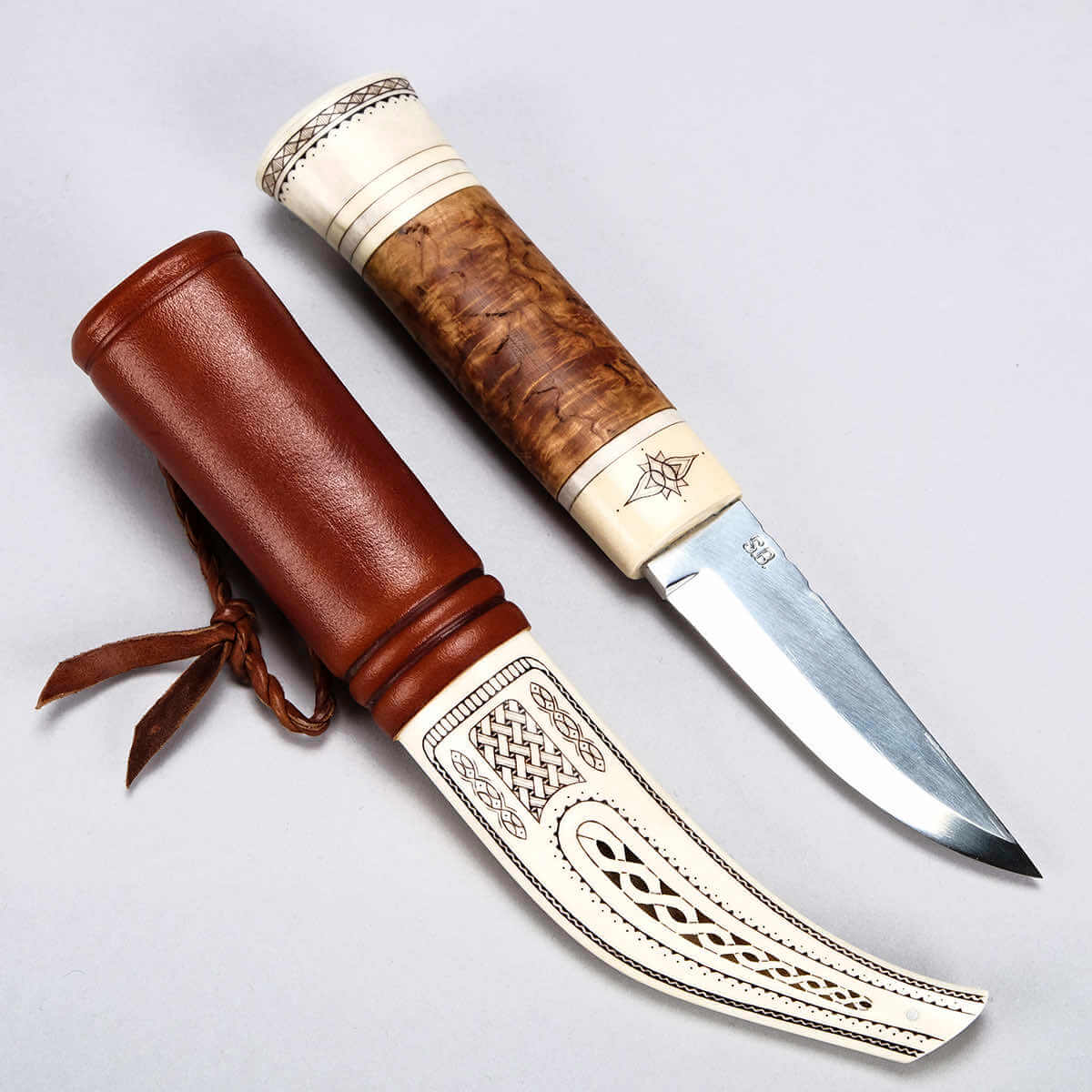
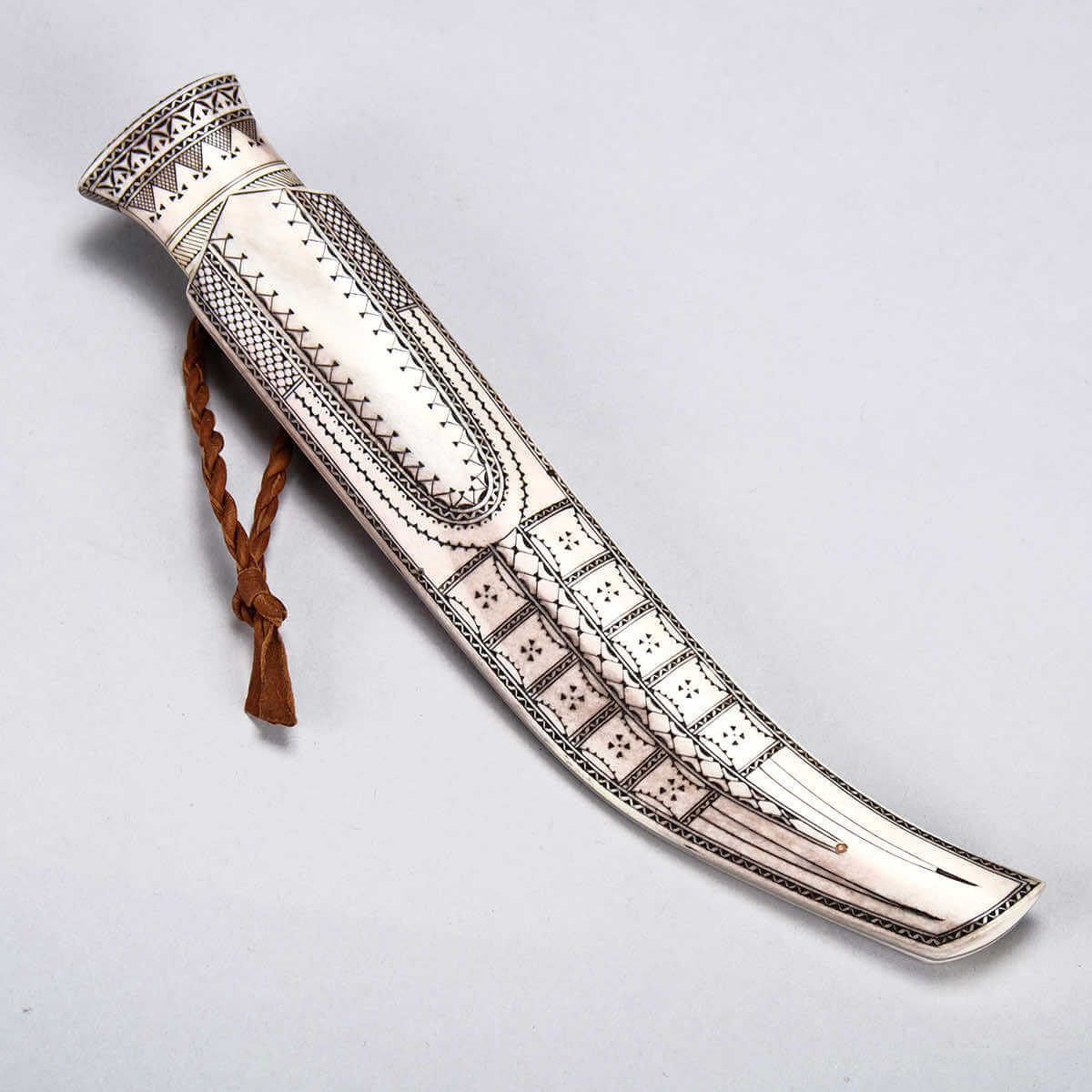
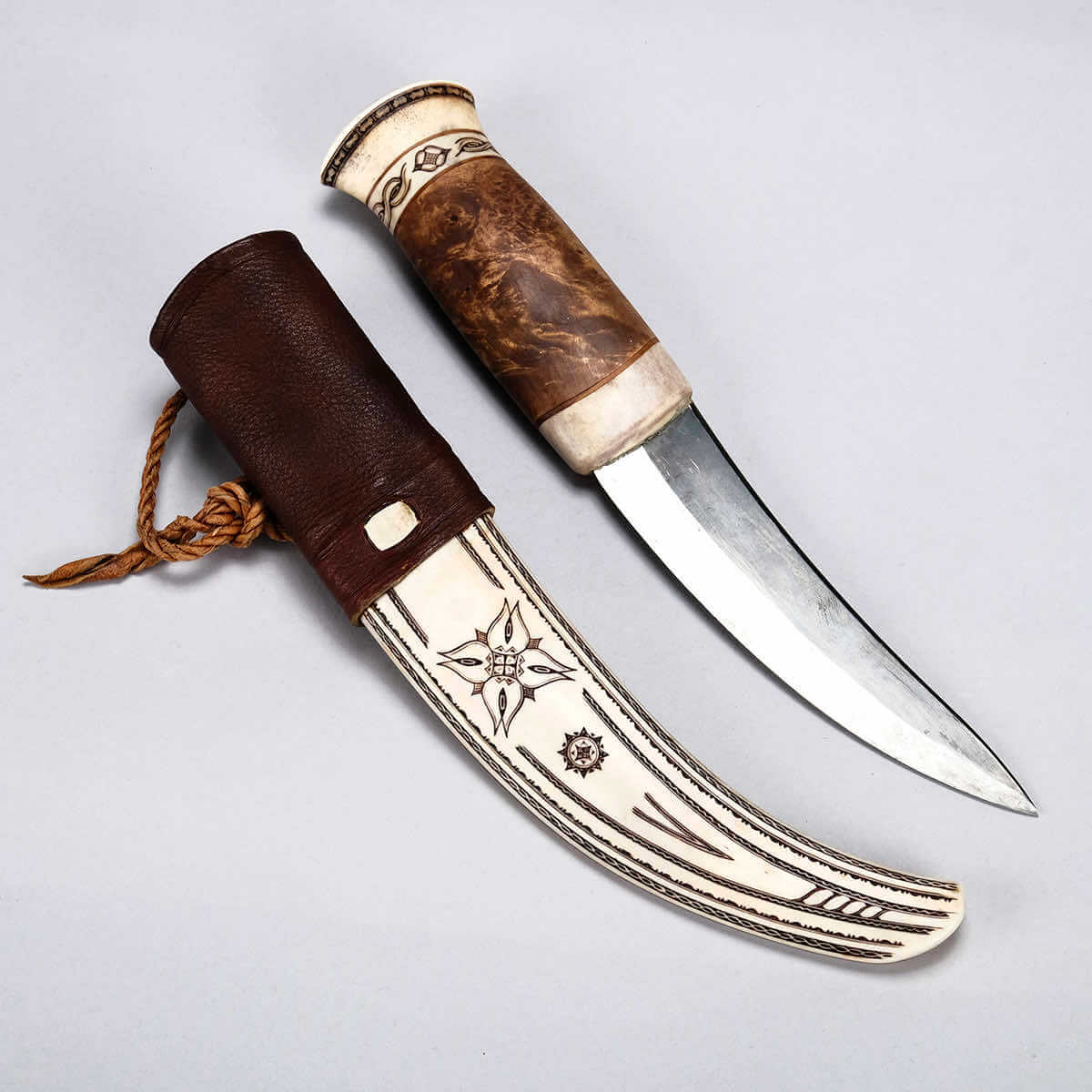
The puukkos face French regulations.
Your beautiful puukko deserves to be taken everywhere in complete serenity. Clarifies together, in a precise way, what the French regulations actually provide for knives.

Contents
Here is a clear and up-to-date summary (summer 2026) of the regulation of collectible knives and knives in France, with a broader overview of Europe. It is mainly based on the Code of Internal Security (CSI), official texts (service-public.fr, decrees and decrees of 2025) and prefectural sources.
Knives & Regulation
1. General framework in France
Weapons are classified into:
- A (prohibited)
- B (authorisation)
- C (declaration)
- D (free acquisition and detention for adults, subject to conditions).
The knives are normally white weapons. According to Article R. 311-1 of the CSI, a white weapon is any object whose sharp, perforating or blunt action is the result of human force alone.
Many knives (including classical folding knives) fall into category D a): « all objects likely to constitute a dangerous weapon for public safety ». This category explicitly includes (since the decree of 4 July 2025):
- The daggers and handlers;
- The knives « butterfly » (balisong)
- Self-opening stop-cran knives;
- The jet stars (« Ninja stars ») ;
- certain mixed weapons (American punch + blade) before 1946.
Acquisition and possession: free for all adults. Prohibited from minors (except for few very framed exceptions, not applicable to ordinary knives).
Port and transport outside the home (public road, vehicle, public transport, etc.): prohibited without legitimate reason.
Port = The object is on itself or immediately accessible.
Transport = object is moved but not immediately usable (packaged, in a chest, etc.).
The legitimate motive is assessed on a case-by-case basis by the law enforcement agencies (and possibly the judge) depending on the place, time, type of knife, profile of the person and context. Self-defence is not a legitimate motive in itself.
Penalties (category D): up to 1 year imprisonment and 15,000 € fine (or flat fine of 500 € in the case of voluntary remission in certain cases). Frequent confiscation.
Important: there is no legal blade length limit that would automatically make a knife « Legal » to be worn. The idea received « less palm size » is false. Even a small Opinel, Laguiole or Puukko can be considered as a weapon depending on the context (e.g. in the city centre at night vs. hiking).
2. Recent developments (2025) – critical points
Two major texts:
Order of 4 July 2025: specifies the list of weapons of category D (a) (paillons, automatics, jet stars, etc.). Non-armor traders who sell these models must now obtain a prefectural authorization to open a business (compliance period until March 2026 depending on the sources).
Decree No. 2025-894 of 5 September 2025: Classifies for the first time certain white weapons in category A1 (prohibited from acquisition, possession and marketing):
- Knives/machettes « zombie » : fixed blade with sharp side + tip + serrated side + (several holes in the blade or several sharp points);
- American punches 4 holes after 1 January 1900 (and some associated mixed weapons).
The holders of these A1 objects had until 7 December 2025 to hand them over to the police or gendarmerie. After this period: up to five years in prison and 75,000 € the fine for private individuals.
3. Collection knives and special cases
- Historical and collection weapons enjoy a specific regime (category D (e), (f) or (g)).
- Models prior to January 1, 1900 (except those deemed dangerous and listed) → Free detention for adults.
- some models after 1900 on official lists.
- reproductions of weapons prior to 1900 under strict conditions.
For collection knives (old, military, regional, etc.), classification depends on the type:
- An old dagger or handler knife remains in D a).
- Some mixed historical objects (punch + blade) prior to 1946 are maintained in D a) through heritage interventions.
- Bayonets are generally not classified « weapons by nature » The same way.
Home detention remains free for adults. Transportation for an exhibition, historical reconstruction or sale can be a legitimate reason (ideally with supporting documents). There is no « collector card » mandatory for simple category D knives (this applies to certain category C firearms).
Practical advice for a collector: keep invoices, certificates of authenticity, photos dated and store coins securely (out of reach of minors).
4. Practical tips for readers of puukko.fr
- Home: Free (major) detention for the vast majority of ordinary and collection knives not classified A.
- On the move: Always store the knife in an unaccessible manner (closed bag, safe) and have a credible pattern + proof.
- Online purchase / import : check the classification (especially for butterflies, automatic or models) « tactics »). Category D import may require an authorisation.
- Minors: sale and detention prohibited.
- In case of doubt: consult service-public.fr (pages on D category weapons), Legifrance (CSI Art. R. 311-2 et seq.), or a specialized armor/lawyer.
Main sources:
- service-public.fr (F2248 – Category D weapons, updated October 2025)
- Decree No. 2025-894 of 5 September 2025 and order of 4 July 2025
- Internal Security Code (R. 311-1, R. 311-2, L. 317-8, etc.)
- Prefectural News Releases 2025-2026
Buy a puukko is legal.
Carrying it can cost you 15,000 €.
Port and transport from home:
prohibited without legitimate reason.
prohibited without legitimate reason.
Acquisition and detention: free for all adults.
Sale to minors: prohibited.
Sale to minors: prohibited.
No blade length limit exists in French law. One puukko, so a knife of 9 cm or 12 cm, is treated in the same way: everything depends on the context.
The legitimate reason is assessed on a case-by-case basis (place, time, person profile, type of activity). For a puukko the following situations are generally well received:
- Outdoor activities (hiking, bivouac, bushcraft, camping) with the knife stored in a backpack in the middle of a coherent equipment.
- Hunting, fishing or work (with possible proofs: permit, licence, professional certificate).
- Transportation immediately after purchase (invoice) or to a cutlery/exhibition.
- Professional use (guides, nature and forestry facilitators, etc.).
Conversely, wear a puukko in a belt or pocket in the city centre, in public transport, in the evening or during a public event will rarely be considered legitimate. Self-defence is never a valid motive.
Practical advice: always prefer the transport (cain in its sheath placed in a closed bag or in the trunk) in the port (immediately accessible). Keep an invoice or photo of the object in its usage context.
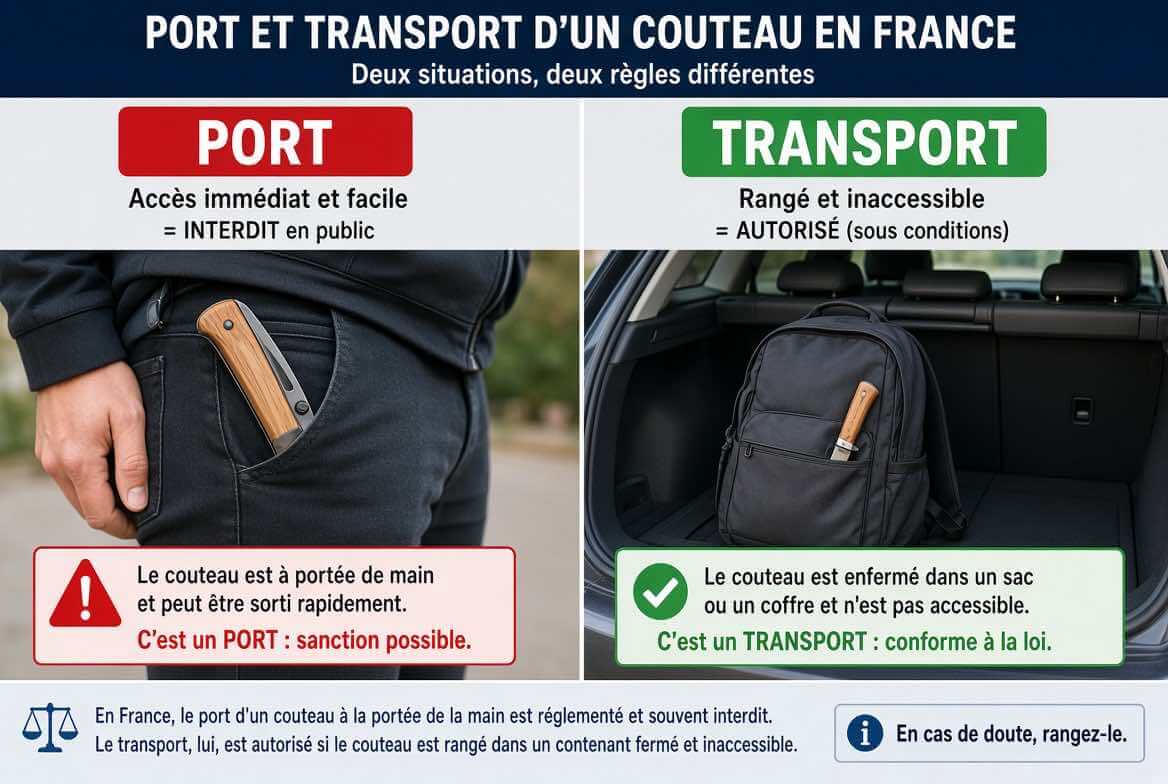
The legitimate motive is not exhaustively listed. It is assessed on a case-by-case basis by place, hour, type of knife, person profile and context.
Self-defence is never accepted as a motive.

Puukkos collection
The old Puukkos, artisanal or historical (Finnish military models, pieces signed by recognized cutlery, etc.) enjoy the same regime. If they have a marked heritage character, their transport to an exhibition, reconstitution or sale can more easily constitute a legitimate motive. No collector card is required for these category D objects.


In summary for those passionate about puukko
One puukko traditional is a perfectly legal tool to acquire and hold in France. Its legal status depends primarily on use and context. Respecting the principle of legitimate motive, properly store the knife and stay in a coherent setting (nature, outdoor activity, collection) allows you to enjoy this Nordic heritage in complete serenity.
Case law and assessment « legitimate reason »
for the transport of knives
for the transport of knives
The legal framework of the legitimate ground

Article R. 315-1 The Code of Internal Security prohibits the carrying and transport of category D weapons (which most knives belong to) without legitimate grounds.
Article L. 317-8 the same Code punishes this offence by one year's imprisonment and 15,000 € fine (with possibility of a flat fine of 500 € in the event of a voluntary surrender of the weapon in the experimental areas).
The legislator has never limitedly defined what a legitimate motive is. The concept is deliberately broad and assessed on a case-by-case basis by the law enforcement agencies and then by the judge in the event of a dispute.
According to the official website service-public.fr (updated October 2025) and recent ministerial responses (notably of 24 June 2025):
« In determining whether you have a valid reason for carrying or transporting a weapon, the law enforcement authorities, or the judge in the event of a dispute, shall take into account the circumstances of place, time, type of weapon carried and profile of the holder. The legitimate ground is examined on a case-by-case basis. Thus, pretending that the weapon would be used to better deal with an altercation or danger is not a legitimate motive in itself. »
Port/transport distinction (DACG 2024)
The Directorate of Criminal Affairs and Pardons (DACG) stated in its doctrine of April 2024:
Port = having the weapon on yourself or immediately usable.
Transport = moving the weapon by licking it with you but *Unusable immediately** (packaged, in a closed bag, in the trunk, etc.).
This distinction is important: the transport is generally easier to justify than the port.
What jurisprudence and official responses say.
The Court of Cassation consistently recalls that the assessment of the legitimate ground is the sovereign power of the judges of the merits (example: Cass. Crime, 4 January 2017, No. 16-80.564). Each situation is examined in the light of the particular circumstances.
Key departmental responses (which are authoritative):
2013 and confirmed in 2025: « The carrying and transport of knives which are not listed weapons is permitted where there is a legitimate motive. The legitimacy of port and transport implies that the knife carried or carried has characteristics of use in relation to the activity for which it is actually used. »
June 2025 (question on Laguiole): The Government stresses that the concept has been designed to take into account the territorial realities and justified daily uses, especially in rural areas. The experiment with lump sum fines does not call into question this contextualised assessment.
Examples of reasons generally accepted (from judicial practice and doctrine):
Direct transportation after purchase (recent invoice).
Moving to a cutlery, armory, exhibition, living room or historical reconstruction.
Professional activity requiring the tool (cooker, artisan, forester, nature guide...).
Coherent leisure activities: hiking, camping, fishing, hunting (with license or associated equipment).
Transport of a tool in a context of domestic or food use (e.g. traditional pocket knife in rural areas).
Examples systematically rejected:
Self-defence or fear of aggression (« in case »).
The simple pleasure of « carry a knife ».
A journey unrelated to the use of the object (e.g. crossing a large city with a puukko under the pretext of a hike scheduled for the following weekend).
Special points for traditional knives (Puukko, Laguiole, Opinel...
Case law and ministerial responses often recognize the cultural and utilitarian nature of traditional pocket knives, especially in rural or outdoor contexts. However, even a Laguiole or a Puukko can be requalified as a weapon if the context warrants it (sensitive location, late hour, carrier attitude, etc.). The criminal judge is not bound by the technical criteria of Customs and can consider almost any knife as category D.
Practical advice from case law
Always prefer transportation: (Couteau in her sheath placed in a closed bag or trunk) in the port.
Have simple proof: invoice, photo of outdoor equipment, license, professional certification...
Stay consistent: the journey, time and place must stick with the alleged use.
If checked: explain calmly and fcurrently. The lump sum fine (when applicable) requires the consent of the controlled person.
Summary in Key Points – Case Law and Legitimate Reason (carrying knives)
Definition: the legitimate motive is not exhaustively listed. It is valued on a case-by-case basis by location, hour, type of knife, person profile and context (service-public.fr + ministerial responses 2013/2025).
- Port vs. Transport:
Port = immediately usable (more difficult to justify).
Transport = not immediately usable (closed bag, safe...) → more easily accepted. - Reasons generally accepted:
Recent purchase (invoice), route to cutlery/exhibition/living room, professional use, outdoor activities (hiking, hunting, fishing, bushcraft) with context consistency. - Reasons systematically rejected:
Self-defence (« in case »), simple pleasure to wear a knife, journey unrelated to the alleged use. - Traditional knives (Puukko, Laguiole, Opinel...):
Their cultural/utilitarian nature is often recognized, especially in rural or outdoor areas, but the context remains crucial. - Practical rule:
Prefer secure transport + simple proof (invoice, photo equipment, license...). The consistency of journey/time/place is essential.
No EU harmonisation on knives.
The rules vary widely from country to country.
European overview (no harmonisation)
There is no single European regulation on knives (unlike firearms). Each country has its own national rules. Here is a simplified overview (to be checked before any trip):
There is no single European regulation on knives (unlike firearms). Each country has its own national rules. Here is a simplified overview (to be checked before any trip):
Germany:
prohibition of automatic knives, butterflies and certain models with one hand opening with locking. Blade limit often around 6-12 cm depending on type and location; reinforced prohibitions in public areas, transport and events. Show cause.
Finland:
port in public without valid grounds has been prohibited since 1977, but application remains flexible in rural or professional areas.
Belgium:
rather strict regime, close to France on the port without legitimate grounds; some more restricted models (dagues, automatics).
United Kingdom:
(especially since the « zombie knives »). Carrying a knife in public almost always illegal without good reason; wide ban on zombie-type blades and many offensive models.
Spain:
Free detention of most ordinary knives at home. Public port subject to justification. Prohibition of automatics, butterflies, stilettos, daggers, etc.
Italy:
recently tightened rules (2026). Some pocket blades ≥ 5 cm with one-manual opening or locking system are strongly restricted or prohibited in public, even with pattern.
Other countries:
(Denmark, Netherlands, etc.): often limits of length (e.g. 12 cm) and prohibitions of specific models (automatics, butterflies).
For intra-EU travel: attention to border and airport controls (lames > 6 cm usually prohibited in the cabin). Historical collection knives can sometimes benefit from heritage exceptions, but this is not automatic.
FAQS
Last updated : August 2026 – The information is indicative. Always check the official texts (service-public.fr and Code of Internal Security).
1. Can we buy and hold a knife freely in France?
Yes. The acquisition and possession of a knife (including puukko) are free for all adults.
On the other hand, sale to minors is prohibited.2. What is the difference between « port » and « transport » ?
- Port = knife is on or immediately accessible (pocket, belt...).
- Transport = knife is moved but not immediately usable (closed bag, car trunk, briefcase...).
Transportation is generally easier to justify than port.
3. What is the « legitimate reason » ?
This is the valid reason why a knife can be worn or transported outside your home.
It is assessed on a case-by-case basis according to location, hour, type of knife and context.
Self-defence is never a legitimate motive.4. What reasons are generally accepted?
- Professional use (cooker, artisan, forester...)
- Outdoor activities (hiking, bushcraft, fishing, hunting)
- Transportation immediately after purchase (with invoice)
- Go to a cutlery, an exhibition or a salon
5. One Puukko Is he considered a weapon?
Yes, like most fixed blade knives, it falls under category D.
His detention is free, but his port and his transport away from home require a legitimate motive.6. Is there an authorized blade length?
No. No legal length limit automatically renders a knife « Legal » to be worn.
Even a small pocket knife can be punished according to the context.7. What is the risk in the case of carriage without legitimate grounds?
Up to 1 year imprisonment and 15,000 € fine.
In some areas, a flat-rate fine of 500 € is possible if the weapon is voluntarily handed over.8. Are the collection knives subject to the same rules?
Yes, in most cases.
Transport to an exhibition, reconstitution or sale may be a legitimate reason (ideally with supporting documents).9. What about automatic knives, butterflies or « zombie » ?
Automatics and butterflies: category D (regulated sale).
Some models « zombie » and recent American punches: category A1 → banned from acquisition and detention since September 2025.10. How does France compare with Finland and Sweden?
- Finland: more flexible. The puukko is a cultural tool; the port is widely tolerated in outdoor context.
- Sweden: system close to France (« befogad anledning »), quite tolerant on small utility knives in rural areas.
- France: tighter on the port/transport distinction and hardened some models in 2025.
11. Can I carry my puukko By plane or train?
- In the cabin: Generally prohibited (strict airport rules).
- In the hold: possible under conditions. Always check the company rules.
12. What to do in case of police control?
Stay calm, clearly explain your pattern and show any supporting evidence (invoice, outdoor equipment, etc.).
Always store your knife in an unaccessible way.
The regulation of knives in France is not there to bother enthusiasts, but to avoid abuse. With a little sense and a clear pattern, you can enjoy your puukko in complete serenity.
Always keep in mind the golden rule: better to carry than to carry, and always to be able to explain why you have your knife with you.
Conclusion:
I hope that this has not been too much of a rebarbatory. French laws are complex, but it is necessary to know at least the broad outlines, especially on such an important subject.
One puukko traditional, or a classic knife, is a completely legal tool to buy and possess in France. Its legal status depends mainly on its use and the context in which it is used. The key element is to respect the principle of legitimate motive: by properly storing the knife and remaining in an appropriate setting (such as nature, outdoor activities or the collection), it is possible to enjoy this northern heritage in complete tranquility.
Last updated : August 2026 – The information is indicative. Always check the official texts to see developments (service-public.fr and Code of Internal Security).
Thanks for visiting, see you soon.

The Blog of puukko.fr
Articles on puukkos, Scandinavia, nature and large spaces.