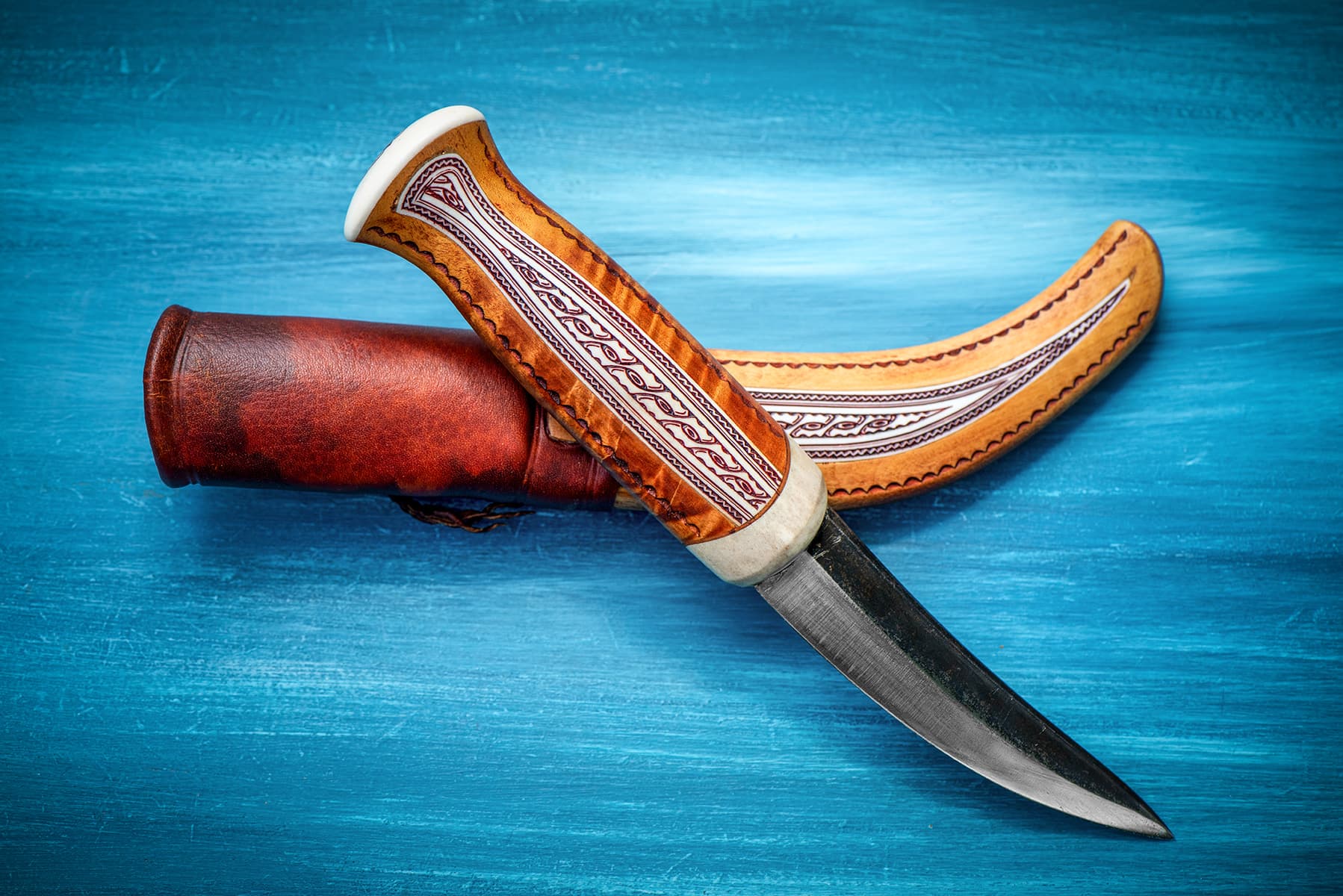
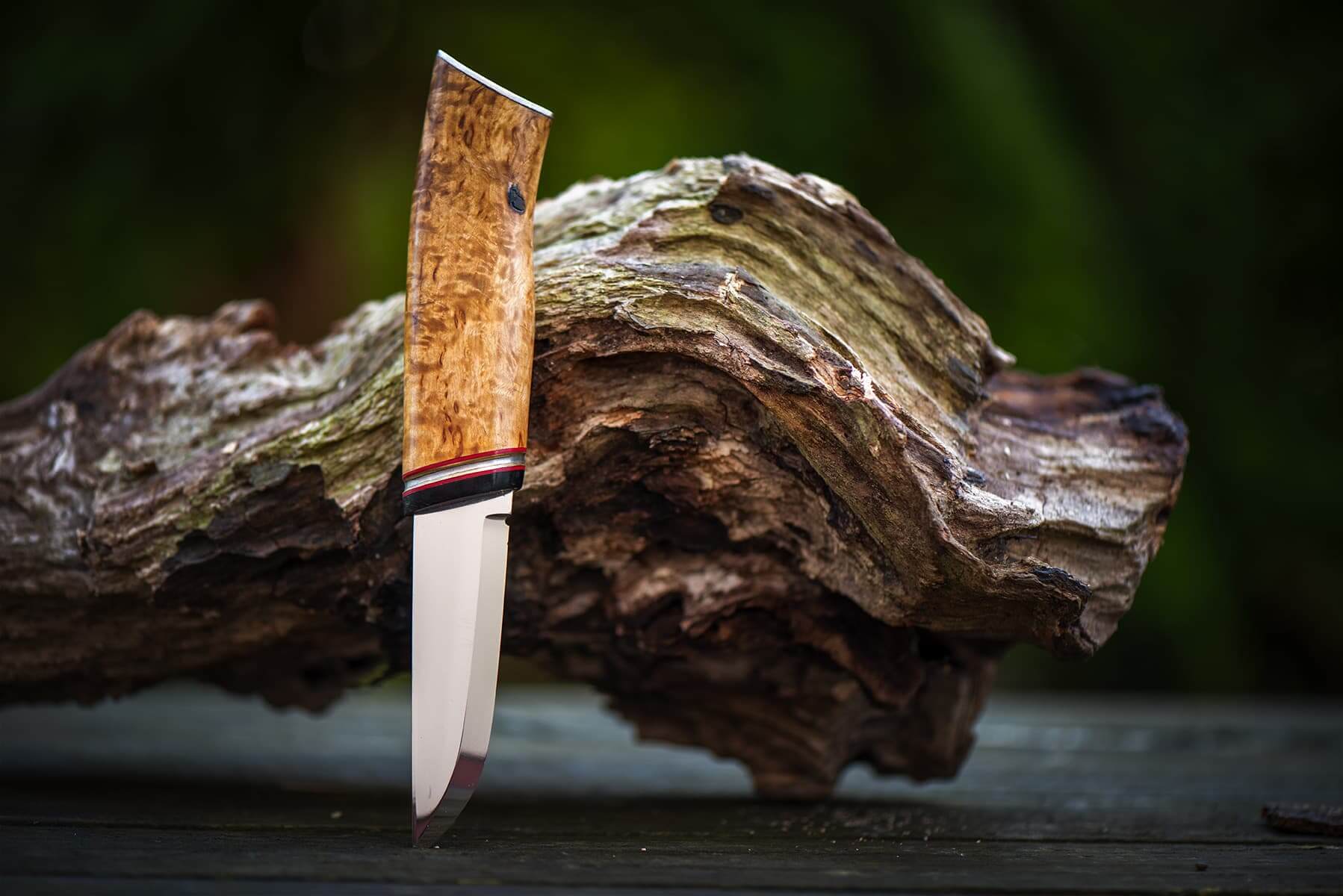
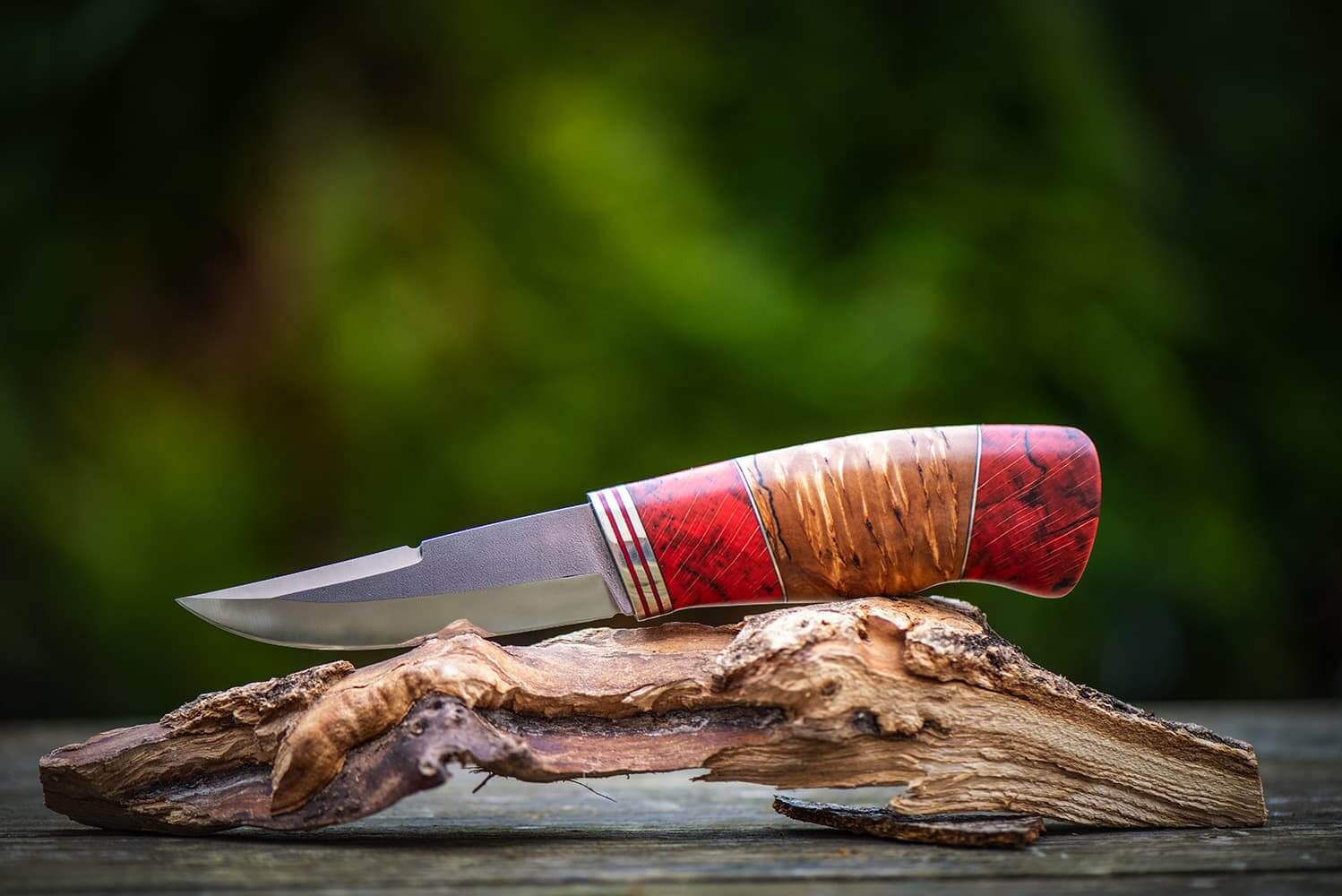
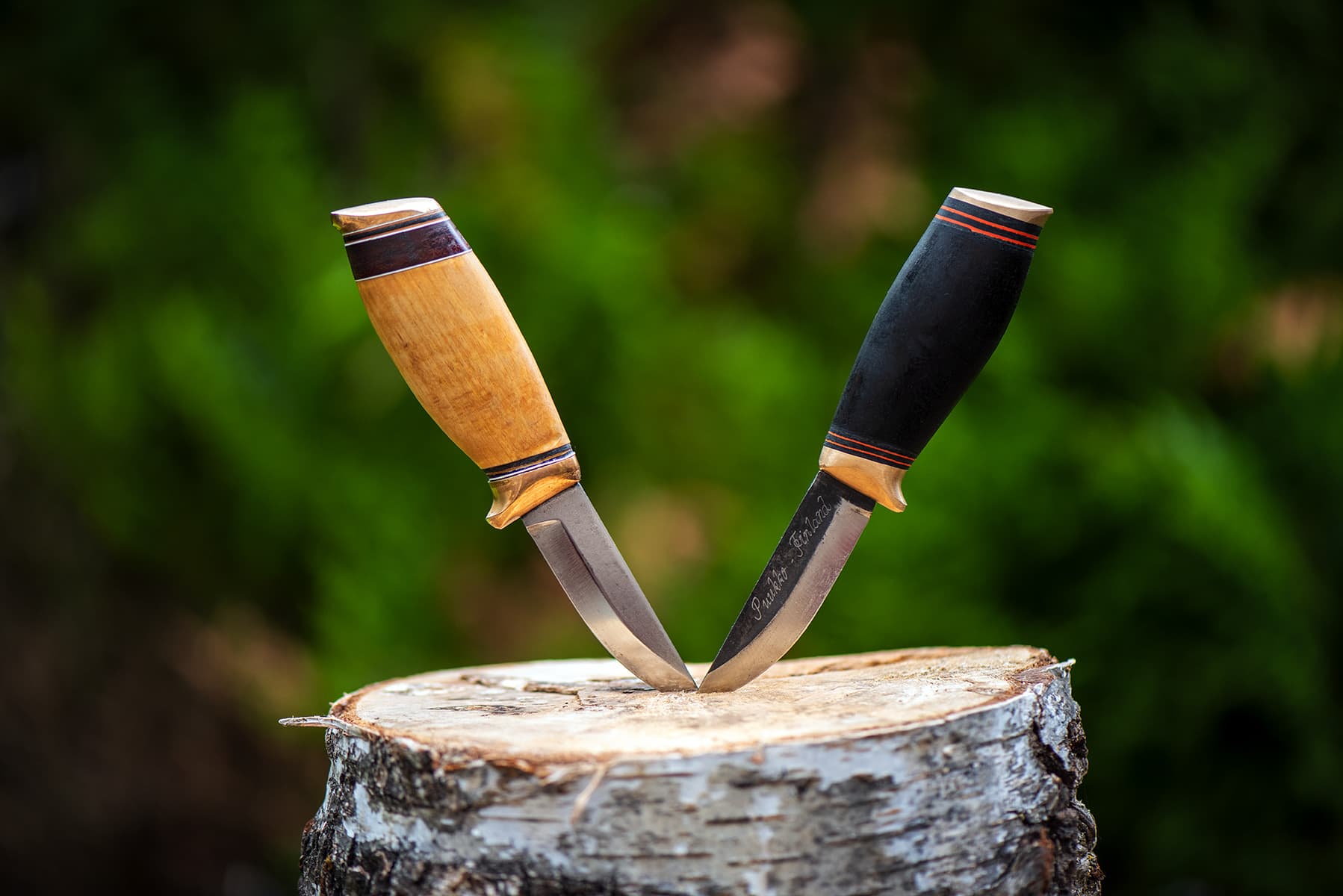
Cutlery is the art of making a knife by hand, from blade to blade handle. Maintenance is a mark of respect for the craftsmen who created these objects, some of which are works of art.
1
Blade
The blade is the most important part of a knife.
I always try to have sharp knives like razors, because what one asks of a knife is first and foremost to cut well! For this, the puukkos are ideal knives and easy maintenance. Before I speak to you specifically about the maintenance of the blades of your knives, I will tell you about the different steels used in their manufacture. However, if you have a specific problem with rust, moisture bites or spots on a blade, follow this link and go directly to the chapter: Maintain the blade of a knife.
Straight knives vary according to steel and size. They are characterized by the extension of the blade in the handle. This part that simmers in the handle is called silk. Its size varies according to the handle. The fixing of the handle is done by bonding, recessing and rivets.
Steels are metal alloys consisting mainly of iron and steel carbon. They are processed in industries for different uses. Of all metals, steel is the one that is susceptible of the greatest hardness. It is therefore the most used in the manufacture of sharp tools. There are several types of steel in the industrial sector.
Hardness HRC
The steel hardness of the blades is measured by the Rockwell test. It is equivalent to the resistance of steel against microshocks compared to daily cuts and will have an impact on the edge of your blade. It is expressed in degrees Rockwell C and abbreviated in HRC.
The Rockwell test consists of supporting a sharp object with a well-defined force against the steel to be tested. The measurement of the left impression makes it possible to identify the hardness of steel.
52 HRC – Too flexible.
52-54 HRC - Correct quality
54-56 HRC – Classic hardness and easy sharpening
56-58 HRC – Professional knives. Squeezing well preserved and easy sharpening.
58-60 HRC – Japanese knives. Slicing preserved and easy sharpening.
60-62 HRC – Hard blade and fragile wire. Very well preserved, but difficult sharpening.
63-66 HRC – Very hard blade with a very fragile wire.
Executive summary:
The higher the hardness of the steel, the harder the blade, but the more fragile the wire. However, the thread is much sharper and more precise than a HRC low hardness knife. Thus, mowing will be less frequent. With a lower hardness, it is impossible to obtain a razor edge. So you will often have to sharpen Your knife, but you won't get a very fine thread. Some rifles sharpen will not be suitable for knives with a high hardness, which is why you will have to opt for stones to sharpen.
The harder the blade, the more fragile it is. This rule is true for both types of steel, whether it is carbon or stainless. A high content of carbon in stainless steel reduces its corrosion resistance.
Knives with damssed blades (a technique about 4,000 years old) have a high hardness and are not as brittle as a simple steel. Their blade is composed of a mixture of hard and soft steel, on several layers, which generates some flexibility. → How to recognize different steels
The blades of the puukko
Carbon or stainless steel
Steels carbon
Many steel knives contain a certain amount of carbon. However, when this composition reaches more than 0.8%, the knife will be considered to be high in content. carbon.
A high-grade steel blade carbon is harder than that of stainless steel. Due to this more pronounced hardness, the blade has a stronger and more robust cutting power. The edge resists for a long time and its use is more convenient. Despite these characteristics, the carbon requires special care. A blade in carbon may take another shade over the course of use. This color change is normal, due to contact of steel with food, air, water. Maintain a steel knife carbon is to avoid rust. Rust comes from poor maintenance.
This is essentially the content of carbon which confers on the alloy the properties of steel.
Steels carbon are martensitic steels whose minority elements have a percentage less than 10. They are designed for hard work, sharp work, and easily sway. There are several types of steel carbon such as:
XC75: Again called Bonpertuis DNH7. It is more used by blacksmiths. Soaked with oil, its hardness rises to 60 HRC.
Carbon V: After-income hardness: 66-59 HRC.
A2: After-income hardness: 60 HRC. It is more used by amateur blacksmiths.
White Steel: After-income hardness: 65-63 HRC. Traditional Japanese steel. Excellent mechanical properties. It is used in the manufacture of katanas and combat blades. But, be careful with oxidation!
Blue Super Steel: Hardness after income: 66-64 HRC. Used by some Japanese artisans to develop blades « Damascus » high-end.
XC100: Steel composed mainly of iron and steel carbon (%1). Harder than the XC75 it is more fragile to bending.
XC48 : Steel carbon higher than for C35 and C40 steels,
XC70: It is the first steel met by apprentices cutlery blacksmiths, expensive and easy to buy.
Stainless steels
The stainless knife, as its name says, does not undergo corrosion. It is easier to maintain than steel carbon, it is ideal for table knives or a casual pocket knife. However, it easily loses its cutting power and requires regular scouring to maintain its sharp power. We can clean it with water.
Note the incredible stainless steel – Damascusteel® RWL34TM used for example in the manufacture of this puukko : The Karesuando Jarven.
SGPS: used in the manufacture of high-end kitchen knives
R2: Very fine-grained steel to obtain exceptional sharp blades.
VG10-: this steel can be tempered between 59 and 62 HRC.
G2: Good compromise between cutting quality, mechanical resistance and corrosion.
ZDP189-
N690Co
CTS XHP
440A: this steel is more resistant
440C: it is better for cutting
440B: These steels offer a good compromise between good cutting and excellent inoxidability.
Grind knives
In cutlery,grind is the part of the blade that sutters and leads to the wire of the knife. It is therefore the whole of the sharp part of the knife and not just the thread.
Although each type of grind It should be borne in mind that the qualities of each of them are closely related to other factors, such as the quality of the steel used and the thermal treatments performed, as well as the geometry of the blade and the final angle given to the edge.
The puukkos have a grind scandi Hey!
Developed in a separate category,grind Scandinavian is a grind flat, but usually has no secondary bevel on the edge. This is made possible by the fact that grind left low, allowing a suitable sharp angle to be obtained directly.
Popular for outdoor activities and bushcraft,grind scandi allows powerful sizes with effective penetration on the supported phases during which it will even have to be careful not to go too far (especially in sculpture). Its qualities make it mainly used on knives intended to work wood more or less finely.
On the other hand, it is less suitable for food preparation when the blade is thick, or for small daily tasks. Benefiting from a sharp sharp edge, it's grind choice of many bushcrafters, and we find it for example on the Mora. L grind Scandinavian has the reputation of having an unsustainable edge. Thus, the angle traditionally given is more acute than on other strides to promote penetration, finesse and cutting accuracy.
L grind The thickness of the back of the blade also makes it easier to split or split, and the thickness of the back of the blade is particularly effective and biting in the woodwork. sharpening is technically easier, but generally longer thanks to the amount of material to remove. This, however, varies according to the habits in the field, because, as with other stumps, a shift to leather at the end of the day is usually sufficient for maintain wire on a steel carbon.
The only constraint in terms of sharpening being the need to use a flat stone. The angle of the edge also remains constant as the sharpening and the grind This keeps it fully effective. The thickness of the blade ensures more strength on lateral stresses, especially at the tip.
Maintain the blade of a knife.
Whatever type of blade or steel is used, you should never put your knife in the dishwasher or offer a prolonged stay in the sink. The advice that will follow concerns both stainless steels and carbon steels. The latter have unparalleled cutting qualities, but require special care. Passing the blade under water a few seconds to clean it is enough to make it clean. Think about drying it well with a dry towel to avoid oxidation of the blade. Most of the time, a dry towel is enough.
Another technique tried by the elders is to soak at the end of the meal the corner of his towel in his red wine to wipe the blade with, guaranteed result.
Any knife in carbon can take another shade over the course of uses, it is a normal reaction of its alloy to the contact of food, air or water for washing... This color will be uniform, often a little darker, as gray. This is part of the charm of the knife carbon Hey!
The blades in carbon must be stored perfectly dry, as they rust easily. Pork fat is a great way to protect your blade. Cut a slice of sausage before storing it, it's a good way to ensure your blade won't rust. During its use, your blade will blacken, skate, nothing serious or dangerous. It is a natural protection that avoids rust and the best way to fight it is to regularly use its knife. To regain the brilliance of his youth, coat your carrossier or cleaner polishing blade MIROR and rub it with a soft cloth.
Maintenance advice:
Stainless steel: Steel stainless steel is a non-oxide steel. It can be cleaned by water easily, take care not to humidify the handle wood and dry the blade well. Important: don't let your knife submerged in the water, as the handle wood could be distorted. It is necessary to sharpen your knife regularly, without waiting for your blade to stop cutting.
Steel carbon : Steel carbon Is a steel that oxides, it takes a patina gray, even black over time. It requires more maintenance than steel stainless steel and addresses informed users. On the other hand, steel carbon has the advantage of sharpening very easily. Clean your blade well after each use, it can be quickly passed under water, but must be dried immediately after with a dry and soft cloth. The knife must be stored in a moisture shelter. In case of less frequent use, I advise you to grease the blade with food oil before storing it dry.
Forge rough: Maintenance of this steel is the same as for a steel carbon.
Damascus: Maintenance of this steel is the same as for a steel carbon ; However, care should be taken to clean the blade immediately after use, without scratching it to preserve the damas motifs.
Clean knife blades:
Moisture particles on blades: These stains are eliminated with a thin canvas emery.
Rust spots: Remove rust stains with a cloth soaked with turpentine essence. Or rub the blade with an onion cut in 2, soaked in sugar powder, or with a piece of potato. Also effective, warm white vinegar with a little large diluted salt and rub!
Black spots: Sprinkle a cloth impregnated with a mixture of table oil and fine ash of wood or cigarette. The operation ends with a microfibre cloth polishing. A tube of polishing paste Puma is also a good option.
Sharpen His puukkos on a stone.
Scandinavian struts have a well marked blade geometry, which serves as a guide during the sharpening on a stone. It is enough to put the edge in contact with the stone. When the blade is flat on the stone, lift the back of the blade to feel the moment when the whole edge rubs against the stone. → Stone sharpening techniques for puukkos
The number of round trips, or time of round trips sharpening, must be the same on one side and on the other side of the blade to always keep the V geometry of the grind. In fact, it is enough to keep the knife perpendicular to the stone and lift it slightly to keep in touch between the stone and the edge.
What grain do I use for my knife?
Actually, it all depends on the wear of the edge, and the cutting power you want. If your knife is particularly blunt, a grain 400 to 600 will be well suited; It will find a suitable edge for most tasks and prepare the ground for a more precise roughing. Then move to a grain 800 to 3,000 to obtain a perfectly sharp knife.
The most manic will use stones of 5,000 or more, but most often a passage to barber leather coated with polishing paste is enough. Once the angle is found, you can start making round trips over the entire length of the stone. Attention must now be paid to keeping a constant angle. I advise you to work your blade by doing small rounds in order to vary the stripes and facilitate polishing of the edge.
Before you start, it is important to know that two solutions are available to you when it comes to sharpening. Either you opt for a sharpening fast and easy giving very good results. This is the perfect solution if you don't have much time and don't really want to invest in this practice. However, you can choose to get an ultimate edge; you invest more time in learning how to sharpen to achieve spectacular results. You can even get a sharper knife than when it was new. To you choose Hey!
Sharpening a grind Scandinavian video...
2
Handle
There are several materials that can be used in the manufacture of handles knives.
A knife is a sharp tool with a blade and a handle to safely handle the tool. These handles allow strong grip for the protection and accuracy of its user. To achieve an ideal finish, many materials are used to make these handles.
The handles Puukkos are very often made of birch wood from Karelia. The birch of Karelia provides a wood that has the appearance of marble; It is used for furniture, interior decorations and various souvenirs. This very rare essence is sold by weight.
The handles Puukkos
All materials
Ball of Karelia
Karelia is an autonomous republic of Russia. It is located between the White Sea, Finland and the St Petersburg region. The hilly relief descends from west to east towards the coasts of the White Sea and south towards lakes Onega and Laduga. The highest point, Mount Nuorunen, 577 m, is located north of the territory. The glacial era, which was completed some 20,000 years ago, left many remains: erratic blocks, sheepish reliefs, multiple rivers and lakes that occupy a quarter of the territory.
The forest, composed of many species, covers half of the territory (reinous: ordinary pine, ordinary fir, Finnish fir, Siberian fir, Siberian larch – deciduous trees: two varieties of birch, trembling, grey - also linden, smooth elm, maple, black - abundant shrubs).
If birchwood is also frequently used to make the handles of our puukkos, it is above all for touch, comfort and grip. But there are other materials such as the horn, the los or synthetic materials...
Never pass in a dishwasher, your knives having a handle Of wood, horn or bone. It's the most aggressive thing you'll do to your handles And they will remind you.
Wood
It is the most commonly used material in the manufacture of handles. Wooden handles are more attractive than most other materials and require a little more maintenance, as prolonged contact in the water loses its value.
Materials of animal origin
These substances shall not be immersed in water for a long time. There are several animal species that can be used. Ivory, deer wood, horns, bones...
Synthetic materials
These are derivatives of plastic products or resins. They are fragile and require a lot of caution. The price is relatively high because of their aesthetic qualities.
Composite materials
These materials are flexible and light, they have a great advantage as handle. They are resistant to moisture and are more suitable for cooking. This is one of the best choices for heavy resistant knives.
Rubber
It is a soft and soft material for handle rubber provides a good grip. It is sustainable and inexpensive.
L stainless steel and aluminium
They are also used in the manufacture of handles for intense use but in the presence of water the handling is a little difficult.
Of all the above mentioned materials, wood is the first and easiest to transform. It is less expensive and exists under several varieties.
How maintain one handle wooden knife?
We all know that dry wood. And, no matter what you do with it. Some wood species suffer more than others but generally a handle wood needs a drop of oil from time to time. This prevents cracks and increases resistance to changes in temperature and humidity. In addition, handle well oiled allows the drawing of wood to remain magnificent.
Since wood is a living material, it probably dilates and patina in contact with moisture. In order to minimize this phenomenon, avoid prolonged contact with water, which would inflate the wood. The handle can pass under cold water very occasionally, taking care to wipe thoroughly after. If the wood becomes dry or tarnished, add a little olive oil or sweet almond oil with a soft cloth to feed it, it will make it beautiful patina.
Use a clean cloth with a few drops of oil. Let oil spread for about 15 minutes before cleaning the handle with another clean cloth. Repeat this until the wood is saturated. In this case, you will quickly notice that the oil no longer penetrates.
How maintain one handle Bone, horn or reindeer wood?
Maintenance is the same as for wood. We must be very careful not to dive the handle in water or exposed to heat, this could break it. Also take care to put a little oil on the handle 1 or 2 times a year to avoid drying up.
What oil to use for handles wooden knives?
Use oil Ballistol, it is very efficient on wood. Only disadvantage, it has an unpleasant smell. Originally developed as an oil for weapons, it is now appreciated for its versatility. It is a mineral oil that revitalizes dry wood.
A practical feature of Ballistol is that you can also apply it on the blade to prevent rust. The oil also works to remove adhesive tape residue on steel or to keep the leather soft. Practice for your sheath Leather. This oil is safe for food.
There is also Danish oil, widely used by carpenters, it is made from Tong oil and penetrates deep into the wood. After application and drying time, rub the handle with a dry cloth. The drawing of the wood is then sublimated. Be careful not to leave too much oil, because once dry, it would reveal a kind of layer of lacquer.
And why not linseed oil. This grandmother's remedy is used as Danish oil. Apply a thin layer on the handle and take care to remove the excess oil, because like Danish oil, this would reveal an unpleasant layer of lacquer.
3
Sheath
One sheath leather, living, patina It's marked...
If sheath leather has long been forgotten, try a good cleaning with glycerinate soap, drying, polishing, then waxing either colourless or tinted. Otherwise instead of waxing, leather grease (we find some in riding saddlery), which will go a little bit further sheath, but uniformly.
If you do not use your knife for a long time, do not leave it in its sheath Leather. This traps moisture and could oxidize the blade or crack the blade handle. L sheath leather, it's only for transport!
The leather used in the manufacture of our puukkos cases often comes from reindeer skins. It is therefore quite normal that the leather has irregularities: wrinkles, scratches or small holes. If skins with large defects will not pass a rigorous selection, small imperfections are a guarantee of authenticity. They will make your sheath leather a unique object that will skate over time.
Leather of puukko cases
L sheath It's only for transport!
Things to do:
Do not expose your sheath in the sun or in the immediate vicinity of a radiator. The excess heat tends to harden the leather and could also alter its color.
Avoid repetitive frictions that can depigment your leather sheath or damage the angles.
Never scratch the surface of the leather with an abrasive sponge, because it would scratch it.
Do not store your sheath in a plastic bag that prevents the leather from breathing. In order to keep it better, prefer fabric bags. Ideally, you will keep it in a cool, dark and dry place.
How maintain sound sheath :
There are countless fats for maintain Leather. Fat will act in penetration and therefore feed deep, soften the leather, and also waterproof. As mentioned above, there are excellent things in the middle of riding. The best known fat is SAPO. Based on vegetable and mineral fats, the best contain fish oil or bee wax. Do not abuse it, otherwise the leather will remain fat and sticky.