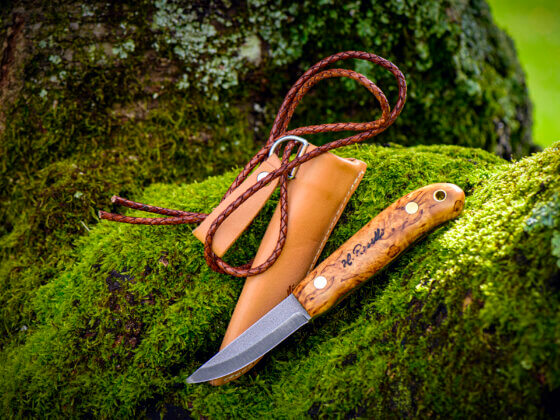
One puukko well maintained is not only a tool that cuts better. He is a companion who goes through years, forests and sometimes generations.
« A man without a knife is a man without a life... But a man with a badly maintained knife is a man who betrays his tool. »
This guide gives you everything you need to get your puukko remains sharp, beautiful and faithful, whether steel carbon Traditional or stainless steel modern.
1. Basic gestures after each use
These five simple actions do 80% of the work. They take less than two minutes.
- Clean the blade with warm water (possibly with some mild soap)
- Dry immediately and completely with a clean cloth (special attention to the thread and heel)
- Apply a thin layer of oil over the whole blade
- Check that the handle and sheath dry
- Put the knife back in its sheath Only when everything is perfectly dry
My advice: Never leave a puukko carbon dry in the open air. Ambient humidity is his enemy number 1.
2. Wiring and stropping
One puukko scandi easy to sharpen. The key is regularity more than technical perfection.
| Frequency of use | Stropping (leather) | Aguisage on stone |
|---|
| Daily / outdoor intensive use | Every 2-3 days | Every 3 to 6 weeks |
| Regular use (hiked, kitchen) | Once a week | Every 2-3 months |
| Occasional use / collection | Once a month | 1-2 times a year |
Find my detailed tutorials:
3. Maintenance of different materials
The blade (especially steel carbon)
Steel carbon develops a patina grey over time: this is normal and even desirable. What's not it is red rust.
The handle
| Material | Recommended maintenance | Frequency |
|---|
| Birch / curly birch | Flax oil or camellia oil | 2 to 4 times a year |
| Birch bark | Very light oil + wiping | 1-2 times a year |
| Reindeer wood / horn | Bee oil or wax | twice a year |
The sheath Of leather
Leather likes to be fed. One sheath too dry cracks, a sheath too fat attracts dust.
4. Long-term storage
One puukko does not like wet cellars or hot radiators.
- Stable temperature (ideally 15-20 °C)
- Relative humidity between 40 and 55 %
- Lightly oiled blade
- Sheath separate if stored for several months
5. Complete seasonal checklist
Spring (March – May)
Purpose: to leave the winter and prepare the outdoor season
- Complete inspection of the blade with light (rust, micro-splinter, deformation)
- Refurbishment guide if necessary
- Deep cleaning of sheath + application of a leather balm
- Generous oil handle (it often dried during the winter)
- Sharpness test on soft wood (sail or lime)
- Verification of rivet and silk condition
- Controlling the adjustment of the knife in the sheath
Summer (June – August)
Objective: to withstand heat, sweat and moisture
- Systematic cleaning and drying after each exit
- Watering of the blade more common (transpiration + rain)
- Check that the sheath never stays wet inside
- Regular stropping (the stinging edge faster in intensive use)
- Monitoring of handle (risk of micro-cracks with heat)
- Avoid leaving the puukko in the sun in a car
- Weekly check if daily use
Autumn (September – November)
Purpose: Large end-of-season cleaning and winter preparation
- Large full cleaning (lame, handle, sheath)
- Cared for winter
- Reinforced anti-rust treatment of the blade
- Full feeding of leather sheath
- Generous oil handle
- Careful inspection of all attachment points
- Disposition: long-term storage or winter use?
Winter (December – February)
Objective: optimum conservation in dry air of heated interiors
- Monthly control of the blade (dry air of the houses dries oil)
- Light but regular blade oiling
- Storage in a stable location (no radiator, no wet cellar)
- If outdoor use: extreme drying after each output (condensation)
- Monitoring of sheath (leather can harden with cold and heat)
- Verification that the handle Not too dried
- Once a month: puukko, inspect and re-oil
6. Common problems and solutions
| Issue | Probable cause | Solution |
|---|
| Small rust spots | Residual humidity | Rub with fine abrasive gum + re-oil |
| Blade that no longer holds the wire | Incorrect sharpening angle or tired steel | Take over grind scandi on stone |
| Handle who splits | Too dry or heat shock | Flax oil + light sanding if necessary |
| Sheath that smells like it's contained | Stagnating humidity | Allow to dry in open air + leather balm |
7. Products used (without partnership)
- Camellia oil or food mineral oil for the blade
- Raw flax oil handles Of wood
- Leather balm (Lexol type or equivalent)
- Japanese stones 1000/300 or natural stones
- Strop leather mounted on wood
Download the complete checklist in PDF
Careful printable version with all seasonal checklists, maintenance tables and essential gestures.
Ideal to keep in your workshop or in your hiking bag.
Download PDF for free8. Conclusion
One puukko well maintained becomes a companion of a lifetime... and sometimes generations.
Take care of it as one takes care of an old friend: regularly, with care, and without ever neglecting it. I wish you a nice date with your puukko.
Well friendly
— Philippe Sainte-Laudy
Puukko.fr – Jura, France