
How to carry your puukko

LAW

PORT

CHANGE

How to go out with your puukko in the forest or hike and why the closed bag is better than the belt in town.

This guide is for you who want to carry your puukko.

Tips from puukko.fr on taking your puukko out with you.

A puukko is worn in his sheath, not by hand. The leather holds the blade, the belt places it, and the bag makes it unusable right away. The right port is the one you forget, and you can explain.

THE PUUKKO IS A TOOLNOT A WEAPON.
Tips on how to wear it

The sheath is the port. The belt is just a place. In the forest, puukko falls under hand. In town, it stays in the bag, blade covered, and unusable right now.

Read first

1. The sheath first

The port starts with the sheath, Not through the belt. One puukko is lined with a blade, up to the collar of the handle. No game. If he comes out walking, bowing, or putting on the bag, the sheath is too wide, the passerby is tired, or the friction of the leather has not been resumed.

The mouth of the sheath must not pinch the wire. A leather too hard, a seam that exceeds, or a poorly formed gutter pushes the scandi every exit. The passerby must hold the weight of the knife without tipping forward.

The leather protects, and it holds water. After rain, sap, or blood, wipe the blade before entering it. For several weeks' storage, the puukko fate of the sheath: aerated leather on one side, oiled blade on the other. One carbon forgotten in a sheath, wet rust sheltered from eyes.
→ How to look after your puukko’s sheath

2. On the belt

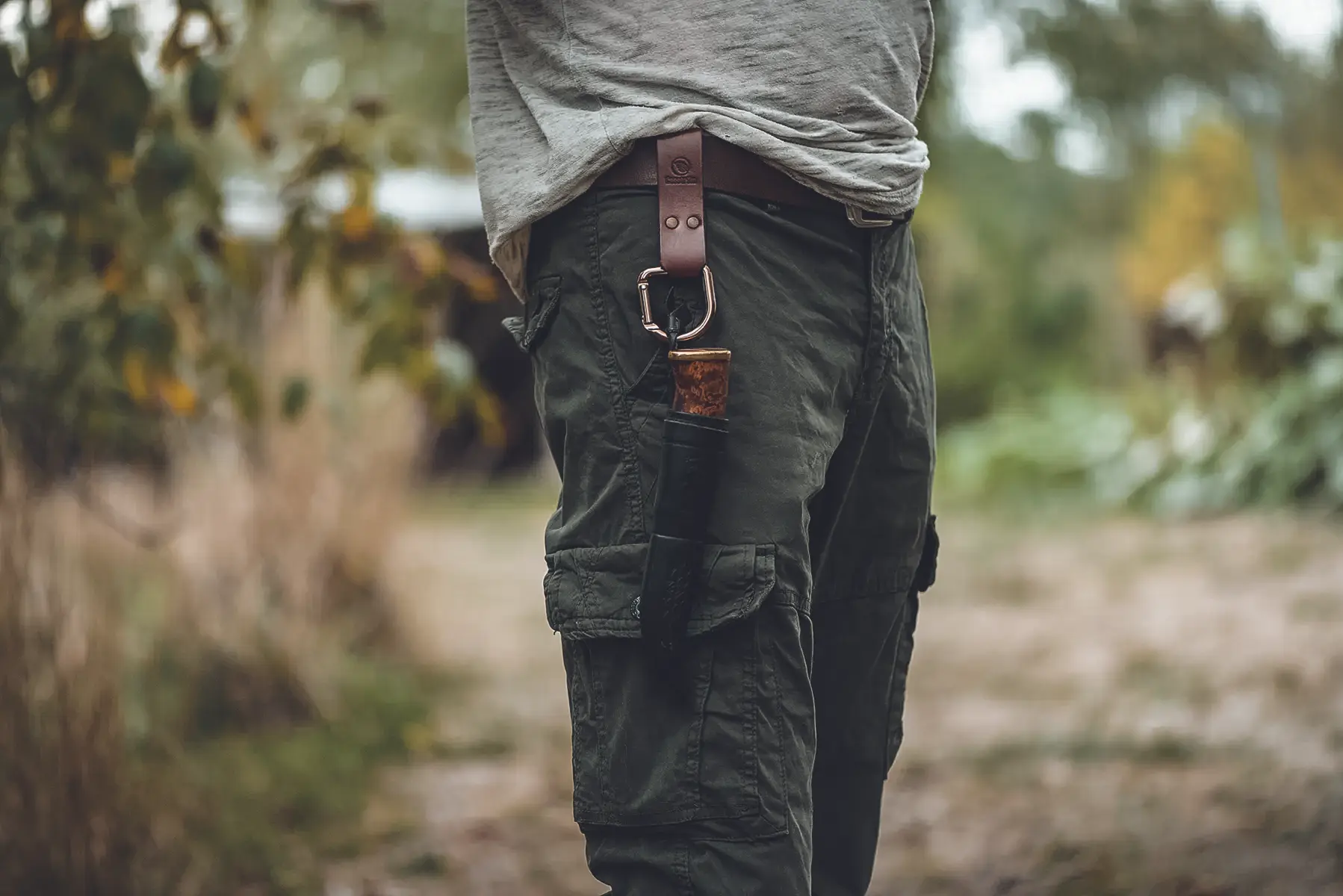
Place it on the hip, blade down. Vertical, or slightly inclined backwards, never pointing forward. Hand falls on the handle without crossing the body and without drawing to someone.

Not in the back: You sit on it, you don't see it anymore, and you hang it in a forest. Not in a pocket of pants or jacket: the handle naked damage the wire, and the knife becomes immediately accessible without being protected. Not in a necklace, or slipped into a boot.

The passerby settles on the real belt, Not on a bag cord. Too high; he's obstructing the backpack. Too low, he beats his thigh. A leuku, heavier, requires a wide passerby and wears less « forgotten » than puukko 9 or 10 cm.

Puukko belt

3. Forest, hiking, bivouac

This is where the belt makes sense. Wood, food, rope, chips: the puukko serves in the hour, not « in case ». The bag must tell the same thing: poncho, stove, stone, not a city outfit.

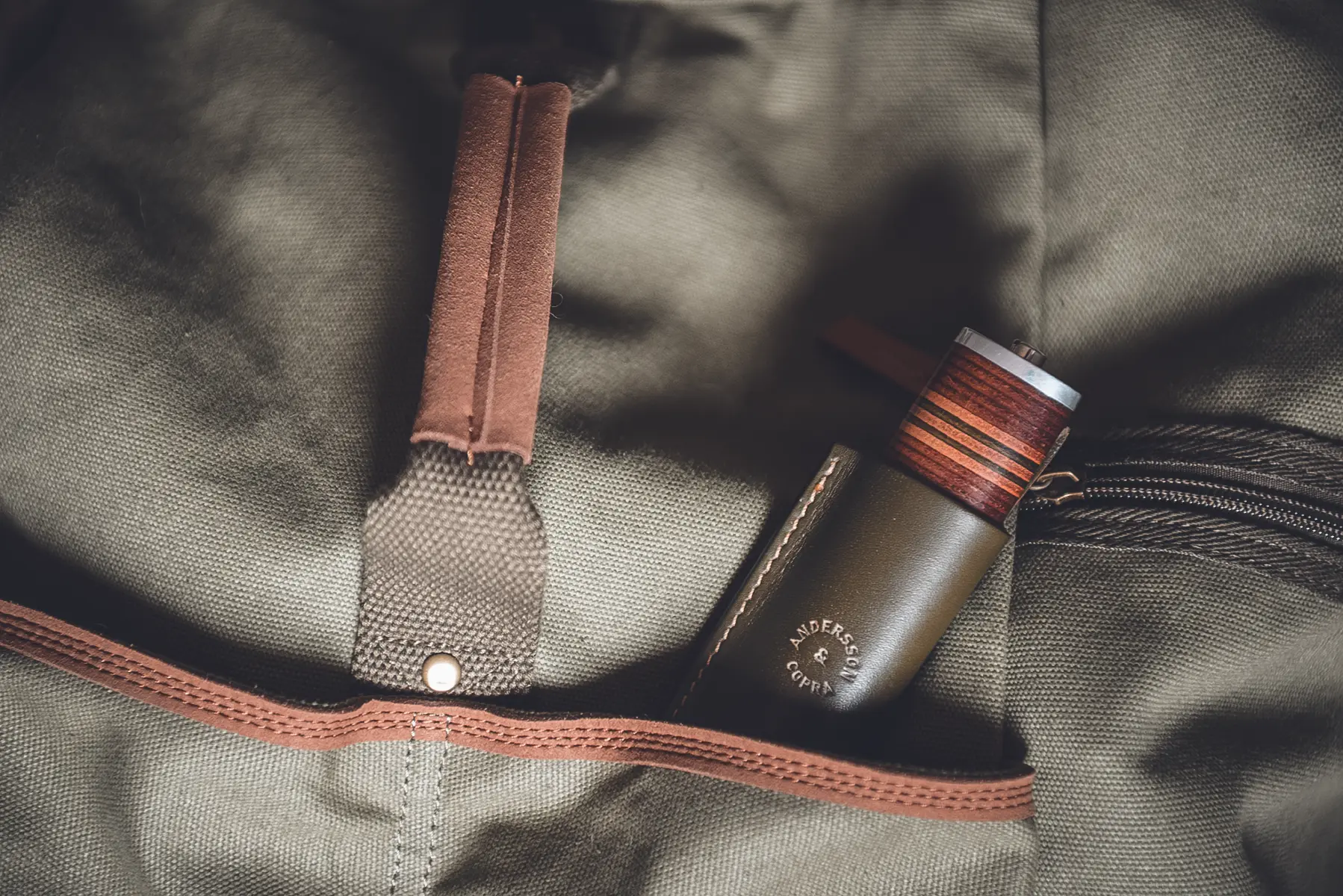
In long walking, Some leave it in the belt; others pass it in an outer pocket of the bag, sheath closed, to prevent it from typing or hanging. At the camp, he returns to the belt or stays within range, never planted in a ball, and never placed in the grass.

In the evening: dry blade, thread-check the finger on the nail and not on the skin, and open the sheath a few minutes if the day has been wet. One carbon oil. A stainless steel is still dry.

Puukko in the backpack

4. City, train, car

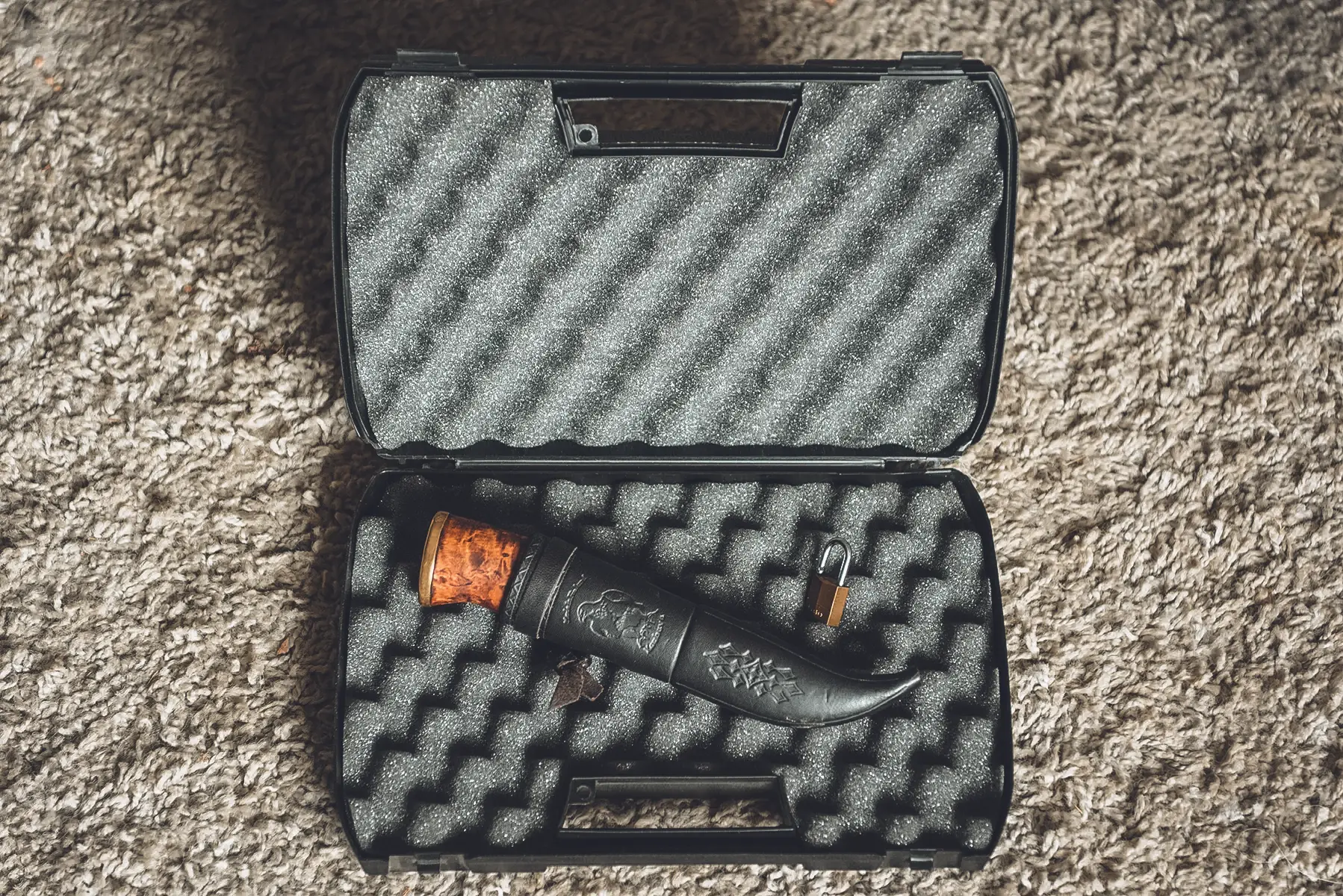
There, transport is better than port. Port: on yourself, usable immediately. Transport: moved, not immediately usable. Sheath, then bag closed or trunk. Not in the downtown belt, not in the subway, not in a coat pocket at night.

No blade length makes the gesture legal. A puukko of 9 cm and 12 cm follows the same rule: context. Hiking, bivouacking, woodworking, direct journeys after a purchase can be a legitimate motive. Self-defense, no. The pleasure of wearing it either. The details are on the regulatory page.

In the car, Safe or bag closed rather than empty pocket. In the train, the bag is closed, not on the next seat.
→ How to secure your puukko?

Storage box for puukko

5. The gesture that closes

We draw downwards and outwards, We work away from the body; we tidy up as soon as the cup is finished. One puukko Out « to have a free hand » and placed on a strain is already a puukko Weak. The sheath is storage. The belt is just a place.
→ How to maintain your puukko?

6. Summary

SituationWhereAvoid
Forest, hiking, campBelt, strong hip side, blade down. Or the outer bag of the bag, the sheath closed.Back, trouser pocket, stuck into a log.
City, transportSealed bag or box. Cannot be used straight away.Belt, jacket pocket, « in case ».
CarBox, or bag closed.Empty pocket, passenger seat.
Rain, snowBlade wiped before sheath. Sheath Aerated in the evening.Carbon in wet, bag closed all night.
Long storageBlade out of leather, oiled, out of reach.Months in the sheath.

FAQ

Carrying your puukko

  • On the side of the hand that pulls out the knife. Most people wear it on the strong side. The opposite is true only if the gesture is already safe.

  • Vertical, or a little backwards. Point forward, and he hangs. Too flat, it beats.

  • Same logic, going wider, carrying more conscious. He is less forgotten than a puukko short.

  • Leather is the traditional port and is patina. The wood protects well if it is adjusted. One modern rigid sheath holds the blade, but this is no longer the gesture of the puukko.

  • We wipe before we get the blade in. Wet leather oxidizes one carbon even if the edge served five minutes.

  • Better not wear it. Carrying it in a closed bag, with a real pattern, is more consistent. No length « legal ». See the regulations page.

  • Sheath closed, belt or bag out of hand, never placed on a table. The detail is in the safety guide.

  • Useful above water or in long sculpture. No need at the port. It does not replace a sheath adjusted.

Are you ready for a 20-question quiz on the puukko ?

Twenty questions, four themes: form, history, manufacturers, and usage. The right format if you have five minutes and want to go to the end.

Conclusion:

Wear a puukko first; it's the tidying. Sheath fitted, blade down, belt only where the tool serves in the hour: forest, camp, wood. Elsewhere, bag or safe. Leather protects the thread and retains moisture; a wiped blade is better than a beautiful passerby.

In France, buying and holding him is free for a major. Wearing or transporting it out of the home is not without legitimate reason. No blade length changes the rule. Self-defense is not one. City, train, evening: a puukko the belt is rarely justifiable. Details, sanctions, and the difference between port/transport are on the regulatory page. One puukko, well-worn, is a tool that can be explained.

Do you have any questions? We're passionate, so do not hesitate to write If you want more answers.

Now you want to know who makes the best puukkos?
You will find the answer here: Which country makes the best puukkos?
A fiercely contested match between Norway, Sweden and Finland!

Warm regards,

Subscribe to the newsletter.

INTERACTIVE MAP OF PUUKKOS MANUFACTURERS

Finland – Lapland – Sweden – Norway

Would you like to find out more about puukkos?

Are you passionate about puukkos? So these articles should also be interesting.

Traditions and Culture in Scandinavia

Traditions and Culture in Scandinavia 1800 1200 Puukko - Finnish knives

When you think of Scandinavia, there are several things that come to mind: Vikings, cold, ABBA and IKEA. Personally, the puukkos add to this list. The Puukko is...

What makes a good puukko?

What makes a good puukko? 1798 1200 Puukko - Finnish knives

What is a good puukko ? Puukko is the Finnish word for « knife ». He is an old friend of any hiker, hunter or fisherman. You can't have one more tool...

Ernest Delannoy & The Old World Forge

Ernest Delannoy & The Old World Forge 1080 720 Puukko - Finnish knives

Today, puukko.fr is pleased to welcome Ernest Delannoy. Forgeron-French cutlery specialized in the design of puukkos. Here's his story. The Forge du Vieux Monde designs utility knives with a...

Sami Duodji

Duodji, or Sami craftsmanship at its finest

Duodji, or Sami craftsmanship at its finest 2200 1290 Puukko - Finnish knives

Duodji means craft in Sami Sami culture has many emblematic terms, including duodji – the Sami craft – is part of it. Tools, clothing and accessories from the duodji...

    EnglishenEnglishEnglish