

NORTHERN GLOSSARY
The words of the puukko
A friendly little lexicon, so you feel at home here. — whether you arrive with your first knife or with a collection already well supplied.

We don't play experts here. We simply call things things, as we would around a fire.
The puukko comes from the North: forests, lakes, working hands.
This lexicon helps to read an article, to talk with a craftsman, to choose A blade without losing you in the jargon. You can go through it with a treat or come back like you open a notebook. Words are grouped by family, not only by alphabet: it is more alive.

Symbol of Scandinavian culture!
The puukko is characterized by a simple and functional design!
Ils sont généralement inspirés des traditions nordiques. La longueur de la lame varie traditionnellement de 8 à 15 cm, procurant un bon équilibre entre maniabilité et capacité de coupe. Les lames sont souvent en acier carbone ou en acier inoxydable, tandis que les manches peuvent être en bois de différentes essences, comme le bouleau ou le frêne. Chaque partie de sa conception contribue à sa fonctionnalité, en faisant un choix idéal tant pour les tâches quotidiennes que pour les activités en plein air. Le puukko est un outil polyvalent, apprécié pour sa simplicité, son efficacité et son confort d’utilisation.
LEXICO
The words of the Scandinavian knife
1 – The knife
1. Puukko
In Finnish, « knife ». But, not just any. Short blade, often 8 to 12 cm, flat back, no guard, handle which fills the hand. Life tool before being a display object. All puukkos are knives; Not all knives are puukkos.
→ The history of the puukko2. Leuku
The big lapon brother. Longer blade, wider, thought for camp, wood, sometimes meat. In the Sami, leuku and small puukko One works hard, the other is precise.
→ Leuku: anatomy, history and technique of the large Sami knife3. Unna / small puukko
Short version, often worn daily. Ideal for fine sculpture, bivouac cuisine, detail. If you begin, a 9–10 cm remains the most generous compromise.
4. Vaarinpuukko
« The puukko Grandpa's ». A classic Finnish form, simple, a little more robust, made to last a life and pass on. When you say that a knife has soul, you often think of that one.
5. Nikkarinpuukko
Knife of the carpenter, the sculptor, the wood maker. Blade sometimes a little thinner, very comfortable in the slöjd. Roselli made it a famous model.
→ Nikkarinpuuko from Roselli6. Eräpuukko
Puukko wildness, hunting and forest. A little more blade, a sheath Ready for the belt, nothing superfluous. He's the companion of a camp, not a window.
7. Tommi
Kainuu tradition, east of Finland. Blade often elegant, handle characteristic, strong regional identity. A name to know if you collect beyond the big brands.
8. Aito
« True »In Finnish. At Iisakki Järvenpää, the Puukko Aito refers to a knife in the purest utilitarian tradition: simple, honest, made to serve.
→ Puukko Aito de Iisakki Järvenpää9. Mora
Swedish labour knife, cousin of puukko. Often more accessible, sometimes handle synthetic and sheath plastic. Useful to know, different mind: the puukko Cultivates more wood, artisan's hand, history.
10. Yakut
Siberian yakoute knife. Asymmetric blade, one hollow side, the other convex. Not one puukko But a cousin of the cold. We're talking about it here because the tools in the North are responding.
→ Yakut, the traditional Russian knife11. Sami knife / duodji-puukko
Puukko born in Sami craft: reindeer wood, tin yarn, leather, engraving. The tool remains a tool; The ornament tells who made it and for whom.
→ Where to find collectible puukkos?12. First puukko
In the North, offer a knife to a child — when ready — is not an insignificant gesture. It's trust. The blade is short, the sheath The clear lesson is that we respect what we hold.
→ How choose your first puukko13. Cultelluphilist
Behind this rare word is a simple and profound passion: love of knives.
Not just as tools, but as objects loaded with gestures and memory. And, among all the knives in the world, there is one that occupies a special place in my heart and on this site: puukko, this Scandinavian knife both rustic and elegant, born in the forests of the Great North.
→ Cultelluphilists: who are we really?
2 - The blade
1. Grind Scandinavian (scandi)
Flat bevel, unique, that descends to the edge. No hidden bugs, in principle. Easy to sharpen on a stone, even in the forest. It's the soul of puukko : simple, predictable, efficient for wood.
2. Scandi zero
The bevel goes up to the wire, without a second angle. Very sharp, a little more fragile if you force. A lot of artisans like that. Others add a micro-wire for real life.
3. Micro-bevel
Any little extra angle on the wire. Unseen for the pressed eye. It protects the edge without betraying it grind scandi. Eternal debate around fire: purists versus pragmatics.
4. Flat back
The top of the blade remains straight. You can put the thumb down, control, push. Unlike many very curved hunting knives.
5. Window / edge curve
Slight curve towards the tip. It helps to slice, peel, sculpt. Too straight, the blade becomes a scissor; Too curved, she loses control.
6. Point
On one puukko classic, it remains useful without being fragile. You drill, you burn, you get out. It's not a dagger.
7. Wire / sharp
The cutting line. It's smelled like nails, paper, tomato bivouac. A good yarn is not an obsession of collector: it is the politeness of the knife.
8. Grind convex
Bevel slightly curved. Rarer on one puukko Strict, sometimes seen on camp blades. Solid, a little less simple to recover in the forest than a scandi flat.
9. Steel carbon
Traditional steel. Squeezing alive, sharpening easy, patina Over time. He fears moisture: you dry it, you oil it, you love it. 80CrV2, UHC (Roselli), northern steels not stainless steel... I often prefer him.
→ How to recognize the different steels of the blades puukko (carbon, stainless steel, damas)11. UHC
Ultra High Carbon, Roselli signature. Very hard, exceptional wire, demanding maintenance. Not a steel « easy ». A character, like the country that saw him born.
10. 80CrV2
Steel carbon widespread among contemporary artisans. Good balance hardness / toughness. He takes a beautiful patina. You will see it often in French and Nordic workshops.
12. Stainless steel
Quieter daily, especially near the sea or in the kitchen. A little less « Living » Under the stone, according to the nuances.
13. 12C27 / 14C28N
Stainless steel Swedish Sandvik, clear, clean, predictable. Marttiini and others use them a lot. Less patina More than Sunday morning without rag.
14. Damascus
Welded steel layers, visible patterns after acid attack. Beautiful, sometimes excellent. On one puukko The damas tells the craftsman as much as the cup. It is not mandatory to work well.
15. Hardness (HRC)
Number that says if steel is hard. Around 58–62 HRC for many puukkos. Too hard: the wire breaks. It's too tender, it's sarrond. The craftsman is looking for the right middle, not the record.
- 20-30 HRC: soft steel, ductile parts, simple structural elements
- 40-50 HRC: versatile kitchen knives, robust hand tools
- 55+ HRC: high-end chef knives, precision industrial tools
16. Patina
Sail grey, blue, sometimes almost black as the carbon takes with use and humidity. It's not active rust. It's the memory of your meals, your chips, your rains. We respect her.
17. Rust
Orange dots, stings, surface that seffrites. Here we act: remove, dry, protect. The patina protect a little; Rust, never.
18. Satiner / stonewash
Surface finishes. Satin shows the work. The stonewash hides the traces of the experience. On one puukko Traditional, we often like steel a little crude, forged, honest.
19. Forged / stock demoval
Forged: Fire and hammer shape. Stock removal : the blade is sculpted in a bar. Both can be excellent. Fire adds a story; the file, a precision.
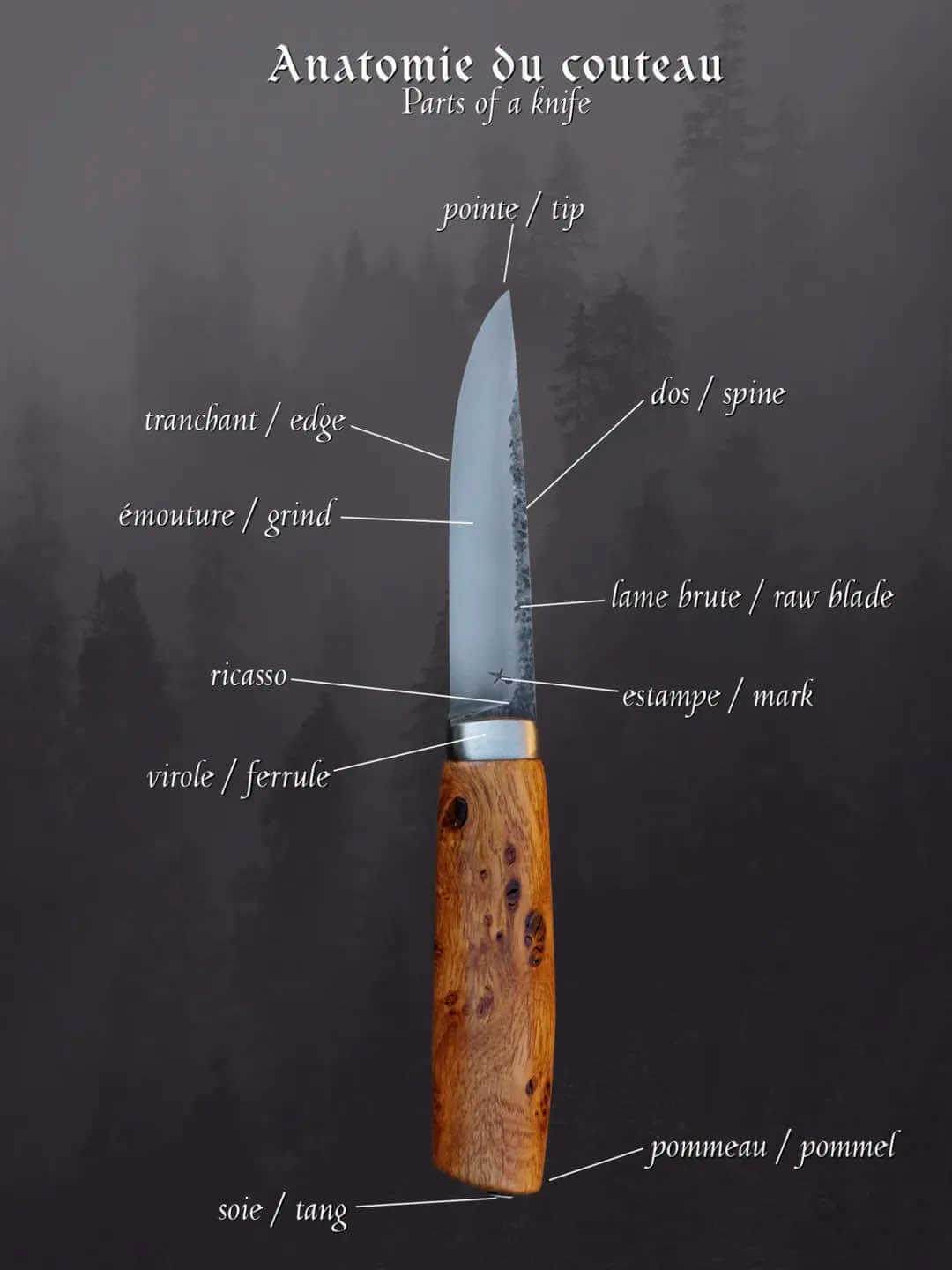
20. Ricasso
The ricasso is a part of the unsharpened blade of a knife. It is a relatively short part, usually not exceeding a quarter of the blade, which is immediately after the guard. The ricasso is unsharpened and serves either to trim or to hold the blade by hand without cutting.
3 – The handle and sheath
1. Handle without custody
Make. Nothing stops hand to blade: where the importance of a handle Well-born, naturally blocking by its shape. You learn to hold, you don't force.
2. Handle barrel
Thicker in the middle, thiner in the extremities. He fills the palm. That's the figure you recognize on a good one. puukko Even from afar.
3. Virole/ferrule
Small metal ring — brass, mesh short, stainless steel — between blade and wood. She dresses, sometimes she squeezes. Not mandatory. On many contemporary models, she signs the drawing.
4. Apple / cap
End handle, sometimes a simple metal plate. It protects the wood and closes the silk. Discreet. Right.
5. Birch
King wood. Light, warm, stable if it is well dried. Flax oil, wax: handle becomes silky and personal.
6. Curly Birch / visakoivu / masur
The birch that waves like water under the ice. Very sought after, especially from Karelia. Each handle is unique. He is often the first one to be photographed.
7. Reindeer wood
Hard work, often Sami. Dense, alive, sometimes inlaid. Less and less artisans really master him. When you get a good one, you feel it.
8. Birch bark
Stacked, pressed, oiled. Take firm, touch unique, very « Aito ». She likes soft maintenance, not imaginary dishwasher.
9. Corn and bone
Ancient materials, warm under the hand. Rarer, more precious. They require a stable climate and a little attention.
10. Tin yarn
Woven or wound yarn, typical of the duodji. Decor that is not in vain: it says belonging, care, sometimes status.
11. Flax oil
Classic wood food. Slim, time, patience. The handle darkening a little and getting deeper.
12. Bee wax
Soft finish, beehive scent, light protection. Often after oil. A very Nordic workshop gesture.
13. Silk (tang)
The part of the blade that enters the handle. Hidden silk (hidden tang) on most traditional puukkos. Fuller silk rarer, more contemporary. A good silk well glued, plucked or stuck is better than an English word on a sheet.
14. Sheath /Tuppi
Sheath, most often in leather, which swallows almost the whole blade and part of the handle — Like a quiver. A good tuppi holds the knife without a button or aggressive pressure. He's patina. He's part of the knife.
15. Belt wear
The puukko stands on the side, accessible, discreet. Buckle, passing, sometimes dangler. In town, you put it away. In the forest, you feel it.
16. Raw leather / tanned leather
The sheath Lives. He's loosening, running, taking your habits. Glycerinized soap, saddlery grease, slow drying: you treat it like a pair of good forest shoes.
→ How maintain tone sheath Of leather
4 - Spirit and culture
1. Sámi / Sami
Northern indigenous people (Norway, Sweden, Finland, Kola peninsula). The puukko is not just a tool at home: it belongs to the costume, gesture, dignity. We talk about it with respect, never like a decor.
→ Sami, Puukkos & Large SpacesThe Sami people, also known as Sápmi (or Sábme in Sami), live mostly in the Arctic circle. The term « Sami » now replaces the names « Lapkins » or « Finish », considered pejorative by the community itself. The Sami are one of the oldest peoples of Northern Europe, and some legends estimate their presence on Norwegian territory for 12,000 years, together with the first inhabitants of the region.
Although the exact numbers of the Sami population are uncertain, it is estimated that this community includes between 100,000 and 500,000 individuals in Norway, Sweden, Finland and Russia. Their traditional way of life varies from nomadic reindeer rearing in northern regions to farming and fishing in coastal areas.
2. Sápmi
The Sami country, across borders. A more true cultural geography, sometimes, than state maps.
It is the Sami name of the region traditionally inhabited by the Sami. Sápmi is a nation without national borders, but within the region there is a language, history and culture that connect the region. The reindeer is closely related to humans and nature, and Sami culture goes back a long way in time. The word Sápmi can vaguely translate into the country of the Sami.
Sápmi is the land and its inhabitants, nature and reindeer. Wildlife and light. The midnight sun and the northern lights. The heat of the open fire during a sparkling winter day and refreshing water from a mountain stream after a long day of hiking. The sapmi is food and products. But also their indigenous rights and Sami names. Duodji (crafts), fishing and Sami tourism. The flag and the Sami colors. The desire to travel and respect the environment. And everything in between.
3. Duodji
Sami craft. Useful first, beautiful then. Knives, kuksa, clothes, tin yarn, bark. A duodji object carries values: correctness, honest matter, transmission.
→ Duodji or craft excellence SamiTraditionally, Sami handicrafts were divided into two sub-groups: male and female handicrafts. Men mainly used wood and wood as well as other reindeer bones in handicrafts, while women used leather and roots. The traditional Sami colors are red, green, blue and yellow.
Duodji artists are still active in Sapmi and still perpetuate the traditions of the duodji. Although there have been changes in traditional duodji, they are now considered valuable works of art by collectors around the world.
4. Kuksa
Birch cup, often carved in one piece. Fire and coffee partner. Not a knife, but the same family of objects: one gesture, one life.
5. Gákti
Traditional Sami costume. The knife has its place in the belt. To see a gákti is to understand that the puukko is not an imported hiking accessory.
Traditional insignia, gákti, are of particular cultural importance and are mainly used for weddings, funerals, confirmations and other cultural events. The appearance of the gákti differs from one place to another and tends to be longer in the south of the Sápmi than in the north. Traditionally, leather, tendons and wool were used to make gákti. Today, velvet and silk can be used at the same time.
6. Kota/lavvu
Northern conical abris. Around the central fire, the knife cuts bread, cheese, firewood. The lexicon then enters real life.
A lavvu is a temporary dwelling used by the Sami people from the northern extremes of Northern Europe. It has a design similar to an Indian tipi but less vertical and more stable in case of violent winds. It allows native cultures on the treeless plains of northern Scandinavia and the upper Arctic of Eurasia to follow their reindeer herds. Lavvu is always used as a temporary shelter by the Sami and, increasingly, by other people to camp.
7. Jokamiehenoikeus
The « rights of everyone » Finnish: walk, pick, camp with measure. It does not allow everything, and especially not any use of the knife. Freedom + responsibility.
8. Large spaces
Here, it means forest, tundra, lake, silence, slow work. The puukko is not a look accessory. That's what you have in your hand when you have to cut, cut, prepare, fix.
9. Slöjd / sloyd
Scandinavian school to do by hand, especially wood. The puukko He's home. Spoon, spatula, single figure: thumb behind, blade controlled.
→ Traditions and Culture in Scandinavia10. Bushcraft
English word for an ancient knowledge: to manage outside. The puukko It shines for detail and wood. It's not an ax. He's not being asked the impossible.
11. Cultelluphilist
Knife collector. I'm part of it, but I'm treating myself. The word makes you smile, but the desire to have more is real. Collecting does not prevent use. One puukko Sorted too preciously forget a little who he is. They look better when you use them!
→ Cultelluphilists: who are we really?12. Places : Kauhava, Rovaniemi, Inari, Jokkmokk
Kauhava: cradle of Iisakki Järvenpää. Rovaniemi: Marttiini and the Lapland Gate. Inari: Finnish Sami heart. Jokkmokk: Winter market, living duodji. Names to put on a mental map.
5 - The gesture and the workshop
1. Sharpening
Give the wire back. Stone, stable angle, little pressure. On one grind scandi You put the bevel flat. When the wire hangs nails, you almost stop.
2. Natural stone / synthetic stone
The stone is the other half of the knife. Average grain to resume, fine grain to finish. One scandi likes flat and honest surfaces.
→ Stone sharpening techniques for puukkos3. Stropping / leather
Finish on leather, sometimes loaded with dough. You pull the wire, you don't hurt anymore. It is the last passage, the one that makes « razor » without removing material.
→ Techniques sharpening leather for puukkos4. Trempe
Heat steel and cool to harden. Then comes the income, so that it is not too brittle. This is the secret that the craftsman keeps in the fire, not in a slogan.
5. Income
Second heat, softer, after soaking. She gives the blade nerve. Without income, hard steel can break like glass.
6. Standardization
Heat cycles before soaking, to calm the metal tension. A word from the workshop. You don't have to do it: you have to know that the craftsman thinks about it.
7. Cutlery / puukkoseppä
The one who makes the knife. In Finnish, puukkoseppä says well « Puukkos blacksmith ». Artisan, not factory. Hand, eye, time.
→ The cutlery of the year in Finland since 20118. Featherstick
Fine cups remained attached to the stick, to light a fire. The puukko excellent: short blade, control, grind Flat. It's a wire-respecting exercise.
9. Sculpture
The puukko Likes wood. Spoon, spatula, simple figure. Away from the knee, you're in control.
→ Manipulate her puukkos10. Maintenance
Dry. Oil the blade carbon. Feed wood and leather. Store dry, out sheath Wet. One puukko Well held through generations. It's a politeness to the craftsman.
→ How maintain his puukkos
6 – Useful references
1. Blade length
Classic: 8 to 12 cm. For starters: 9 to 10 cm. Shorter = accuracy. Longer = camp and wood, a little less finesse.
2. Honest budget
A very good first puukko : often 80 to 250 €. Below, you can find useful. Above, you pay the hand, the rare wood, the damas, the name. No price replaces the grip.
→ How choose your first puukko
3. Traditional marks
Marttiini (Rovaniemi), Iisakki Järvenpää (Kauhava), Roselli, Helle (Norway)... and especially independent workshops in Lapland, Sweden, sometimes France. A brand is not a guarantee of poetry. A craftsman, yes.
→ Which country makes the best puukkos?4. Suomen Puukkoseura
Finnish Association of puukko founded in 1995. Useful if you want to take a contest, cutlery of the year, living culture of the knife.
→ Suomen Puukkoseura5. Cutelier of the year (Finland)
Title awarded since 2011 in the Finnish circle of puukko. A marker, not a dogma. He helps find hands you wouldn't have crossed.
→ The cutlery of the year in Finland since 20116. Source
Who made the knife, where, when. To collect, it is half the object. A photo of a workshop is sometimes better than a too chatty certificate.
7. False / Copy
It exists. Marks dressed in a rush, « Sami » I'm not sure. Beware of miraculous prices and too beautiful stories. Buy the craftsman, not the myth.
8. Law
In France, puukko is not an annoid pocket toy in public space. Transport = legitimate reason (nature, work, purchase, workshop). Updated detail on the dedicated page of the site. The lexicon appoints; the framework law.
→ The puukkos face French regulations.
LEXICO FAQ
Just words, for honest hands.
Where to start if all these words lose me?
Puukko, grind scandi, handle without custody, sheath. Four notions. The rest comes by reading and holding a real knife.
Must I say puukko Or a Scandinavian knife?
Both. « Puukko » is fair and beautiful. « Scandinavian knife » Help those who arrive. On this site, we say above all puukko — with tenderness.
Is it serious if I say wrong?
No. In Finnish, about « puk-ko », U long. The Sami and Finns prefer a clumsy and respectful amateur to an arrogant expert.
One puukko without reindeer wood is it « less true » ?
No. Birch, bark, good carbon and just form is enough. The reindeer is a story, not an exam.
Carbon or stainless steel For a first?
Carbon If you like the maintenance gesture. Stainless steel If you want to forget it sometimes. Both cut. The carbon Tell more.
Can I sharpen too often?
You can push too hard, raise too much bevel, eat too much steel. Smuggling little, well, as soon as it slips instead of biting: that's the rhythm.
Does the damas cut better?
Not automatically. A good one carbon simple, well treated, beautifully cut. The damas adds the drawing and sometimes the price.
Why not watch?
Because the puukko is a tool of thrust and sculpture, not a weapon. The shape of handle And your hand serves as wisdom.
I can take my puukko hiking in France?
Often yes, if use is consistent (bivouac, wood, meals) and discreet transport, blade in. Read the law page before a living room, a train, a city.
→ The puukkos face French regulations.Where to buy without cheating?
At the artisan's house, through the portfolios of the site, or at a traditional house. Avoid fuzzy marketplaces. A real name, a real address, a real blade.
Will this lexicon lie down?
Yes. Every craftsman, every trip, every blade brings a word. If one is missing, write to me. We'll install it by the fire.
Conclusion
One puukko understands first in the hand, then in the words. This lexicon is not an examination: it is a fire around which we recognize ourselves. Keep four concepts — short blade, grind scandi, handle without custody, sheath — And the rest shall come by themselves, in the course of the wood, of the craftsmen, and of the seasons.
For questions related to this lexicon, do not hesitate to write to: contact(at)puukko.fr. We're passionate and I always answer the requests. Think about putting this page in your favorite bookmarks, because you're coming back, for sure.
Warm regards,
Subscribe to the newsletter.
Norway – Sweden – Finland
WHO MAKES THE BEST PUUKKOS?
You want Learn more on the puukkos?
The puukko You're passionate, so these articles should also be interesting.

Northern lights in Lapland
Northern lights in Lapland https://puukko.en/wp-content/uploads/2022/08/Landscape-white-with-aurora-boreal.jpg 1800 1200 Puukko - Finnish knives //puukko.en/wp-content/uploads/2021/05/21.pngThe Northern Aurora in Spanish Spirit Lapland Towards the end of August, the sun finally descends far enough below the horizon for stars to reappear in the sky above...

Puukko Ahti – Finland
Puukko Ahti – Finland https://puukko.en/wp-content/uploads/2023/04 Des-puukkos-Ahti-Finland.jpg 1798 1200 Puukko - Finnish knives //puukko.en/wp-content/uploads/2021/05/21.pngAhti offers several Finnish puukkos models that will meet your needs for utility knife, hunting knife or general use while you enjoy full service.

Viking knife & Amulet
Viking knife & Amulet https://puukko.en/wp-content/uploads/2023/03/Couteau-viking-tete-de-corbeau.jpg 1798 1200 Puukko - Finnish knives //puukko.en/wp-content/uploads/2021/05/21.pngViking knife forged by hand. Handle crow head carved and patinated in original wood. Amulets related to the god of the Odin war. Table of Contents 9mn of...

