


3 million years sharp.
The puukko It represents only the last centuries. Before Finnish wood and steel, there is flint, los and bronze.
The puukko It represents only the last centuries. Before Finnish wood and steel, there is flint, los and bronze.
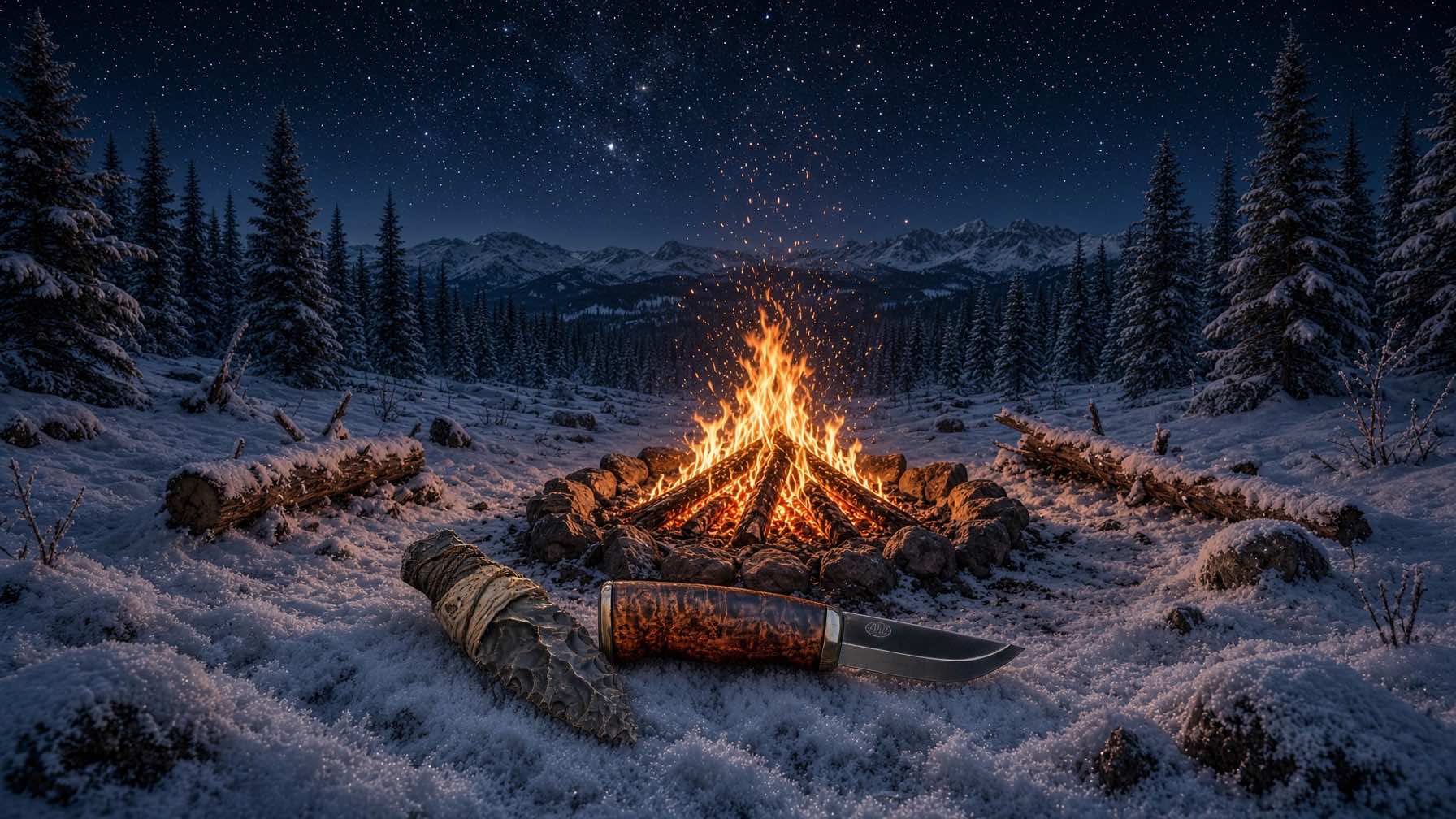
The puukko Don't make up the knife. It's very late.
Before Kauhava birch and steel, There is the flint of Lomekwi, the olduvai, the resin of the Neandertalians, the Egyptian bronze. For three million years, the same gesture: to separate the meat from the bones, the wood from the tree and defend itself.
This article puts puukko in this timeline. Who cut the first edge, when, why — and when the Finnish blade takes shape.
Why this article?
On puukko.fr, I'm basically talking about a precise knife. And it's a pleasure, but to stay there is to cut him off from his story.
The puukko is not an isolated invention: it is a late nordic form of a millions of years old gesture. This article expands the framework for the reader to see where the edge comes from, and why the puukko, by remaining simple, still says the essential.
The knife, long before the puukko.
Cut precedes the human species. Around 3.3 million years ago, in Lomekwi (Kenya), hominines already hit the rock to get a sharp edge. At around 2.6 Ma, the Oldowayen shrapnel became the first « knife » : a voluntary sharp, held by bare hand, to loosen the meat and open the skins.
>Around 1.5 Ma, in Olduvai, Homo erectus is also size: elongated blades, sometimes 40 cm. The gesture remains the same — slit, scrape, boneless — But the material changes. For hundreds of thousands of years, one still holds the edge in the palm. Around 200,000 years old, in Campitello (Italy), Neandertalians stick resin on a radiance: first known. The modern knife is born there: blade + grip.
Upper Paleolithic, The flint and dobsidian blades are standardizing. In the Neolithic region, Northern Europe produces flint stab wounds. The metal arrives late: copper and bronze from the third millennium BC, from the Mediterranean to China. Egypt already sticks the flint in the wood; Greeks and Romans melt bronze, then steel. The knife remains first hunting tool and workshop. The table knife is a late luxury: in the Middle Ages, everyone still wears his or her own belt.
The puukko Don't make up any of that gesture. He inherits it.
Where is the puukko ?
In Finland, lithic forms exist from prehistoric times. The first metal knives « proto-puukko » date from the end of Iron Age / Vendel-Viking era (around 800-1050): short blade to one edge, sheath leather, belt. Around the year 1000: decorated sheaths and handles (bronze).
The guy puukko (handle wood, simple blade, daily tool) is fixed in the eighteenth century. The word comes from puu, the wood. The golden age was the end of the 19th century: Kauhava, Tommi (Keränen, circa 1873), Iisakki Järvenpää (1879). Forest tool, farm, sometimes weapon — Never an isolated invention, nordic specialization of a gesture of millions of years old.
The puukko does not appear with metal. It crystallises in the eighteenth century a form already there since the Iron Age: short blade, a sharp, handle wood, sheath on the belt. Everything else — Tommi, Kauhava, Marttiini — is only the name given to this gesture.
The Sami leuku is not a great puukko. It is another tool, born of forest and cold. The puukko cut and sculpt; leuku splits and flows.
→ Leuku: anatomy, history and technique of the large Sami knife
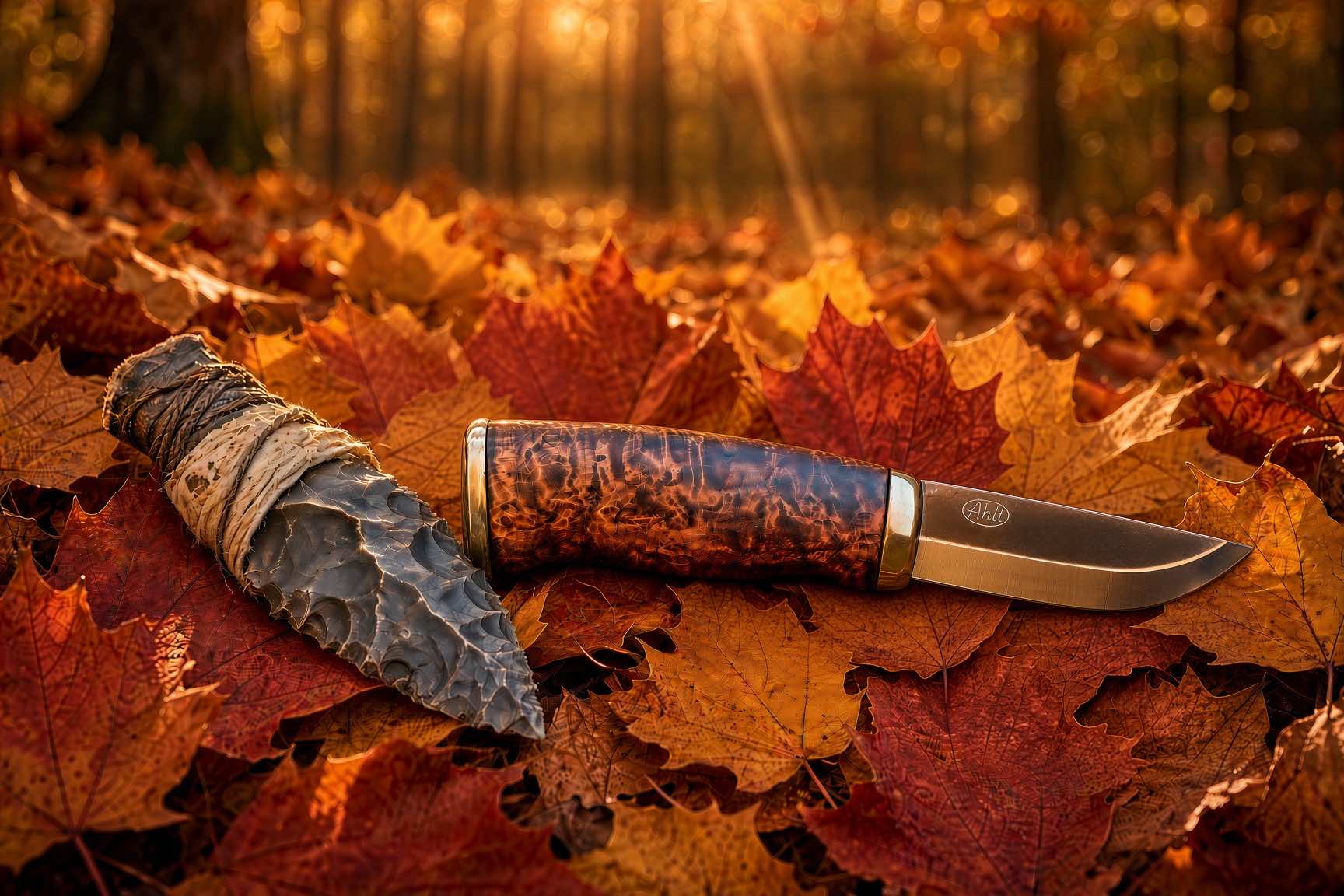
From flint to puukko : chronology
Lomekwi — first tools
Hospitals in Kenya. Pebbles hit to get a sharp edge. Older than Homo.
Oldowayens
East Africa. First « knife » : radiance held by bare hand to cut meat and skin.
Bone knives, Olduvai
Homo erectus, Tanzania. Blades sometimes 40 cm long. Same gesture, another matter.
First range
Campitello, Italy. Neanderthals: resin on a sparkle. Birth of blade + grip couple.
Bronze
Egypt, Mediterranean, China. The metal gradually replaces the flint. Cast blades, longer, more durable.
Proto-puukko Viking
Fennoscandie. Short blade to one edge, sheath leather, belt. Wood tool, hunting, fishing.
Furnaces decorated
Finland. Bronze, engraving, rings. Daily tool starts to wear a status.
Type puukko
Handle wood (puu), simple blade. The Finnish model differs from the other Nordic knives.
Tommi and Järvenpää
Kainuu and Kauhava. The puukko becomes a model named, reproducible, sometimes industrial.
Reputation and factories
Ostrobotnia, häjyt. Fiskars, then Marttiini (1928). The puukko exit the village and enter in series.
Winter War and Future
Only civilian object carried in combat. In Russia, « finka » born of this blade.
Restricted port in Finland
The puukko Leave the street. It remains a tool of forest, construction, Scouting.
Crafts and Collection
Steel stainless steel or carbon, independent blacksmiths, Sami and classic models. The puukko remains a tool, also becoming an object of culture.
Conclusion:
The puukko Don't open the story of the knife. It closes it, on the north side: even need (cut to live), local materials, clean shape. Understanding the flint is to understand why the puukko remained simple.
Don't you want to leave now? As I understand you, look at the links below and continue the visit... And, most importantly, Subscribe to the newsletter not to miss the next articles. You can also comment and share this article on your favorite social network.
To go further:
• The puukko Over the seasons – Full guide + seasonal checklist + PDF to download
• I am cultelluphilist but I treat myself
• The reference book on puukko
Warm regards,

Subscribe to the newsletter.
The puukko A to Z
ALL GUIDES
A complete journey:
choose sound puukko, do it its own, sharpen,maintain, handle it, and secure it with the children.

