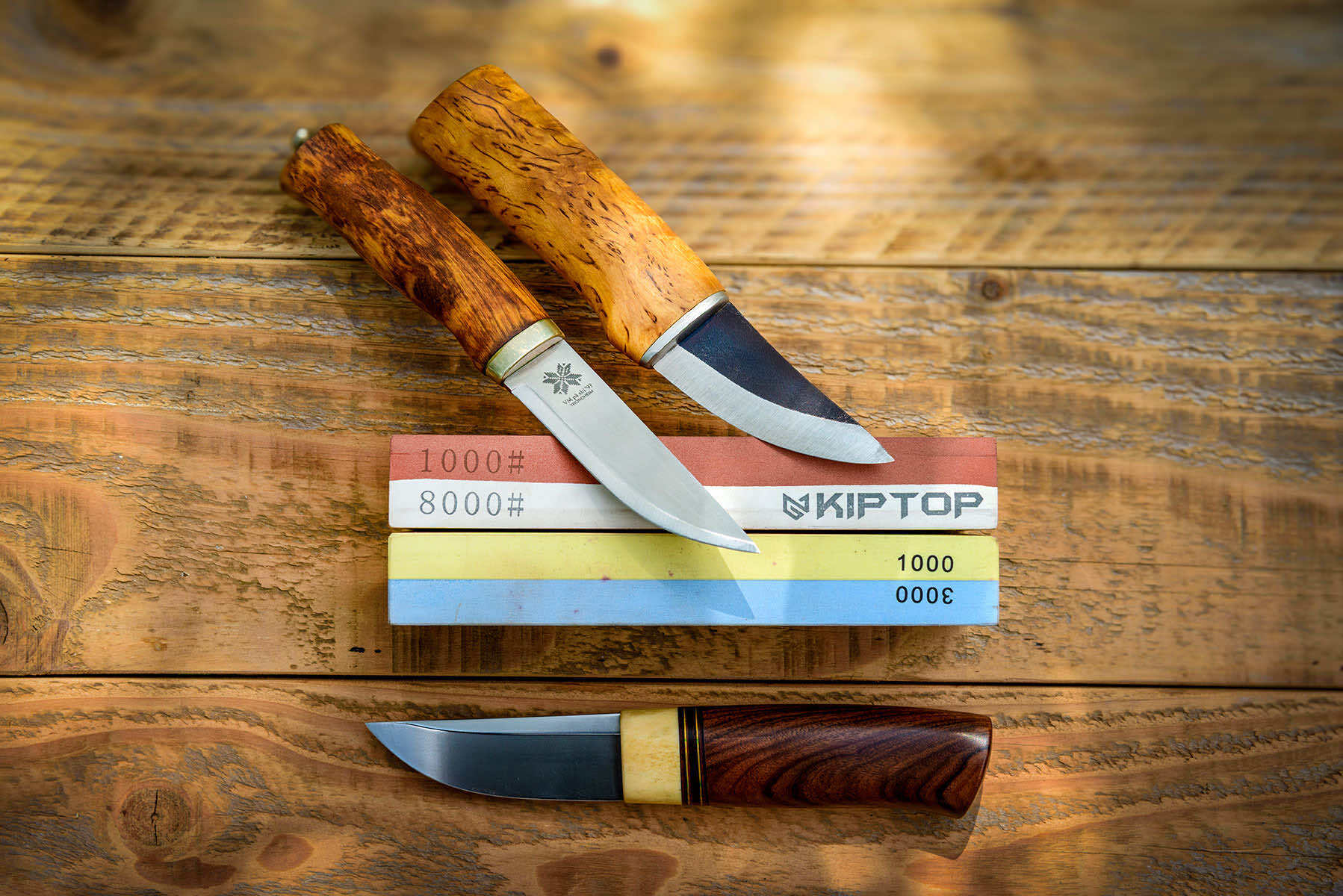
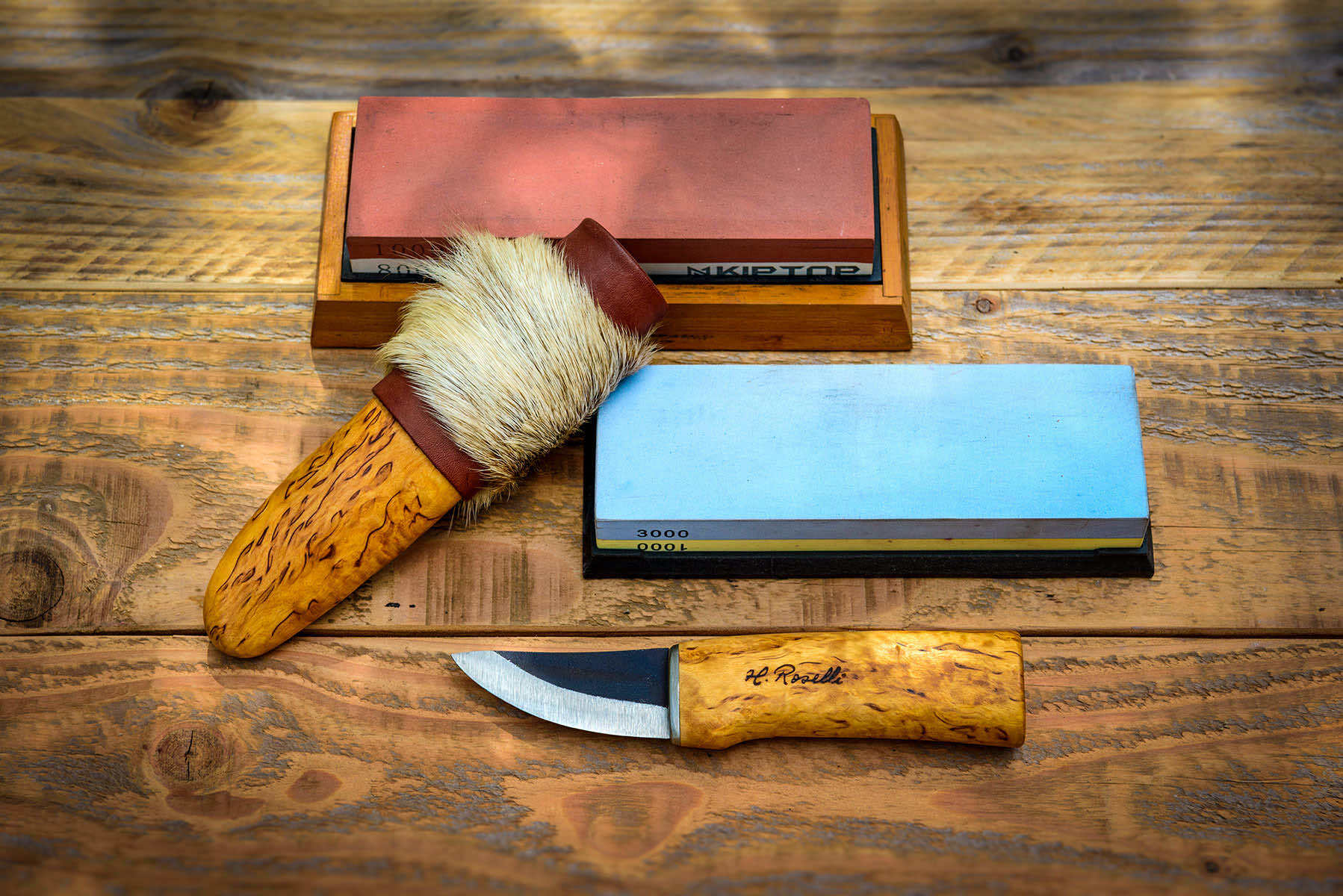
In this guide on stone, we will see together how to sharpen your puukko : choose good particle size, prepare the stone, find the right angle and install a simple maintenance routine, without professional equipment.
I spent hundreds of hours sculpting wood with many Scandinavian knives, making spoons, cups, bowls and much more. Puukkos occupy a special place in the hearts of outdoor enthusiasts and knives. This guide will provide you with the necessary knowledge to maintain a perfect edge on your puukkos.

INTRODUCTION
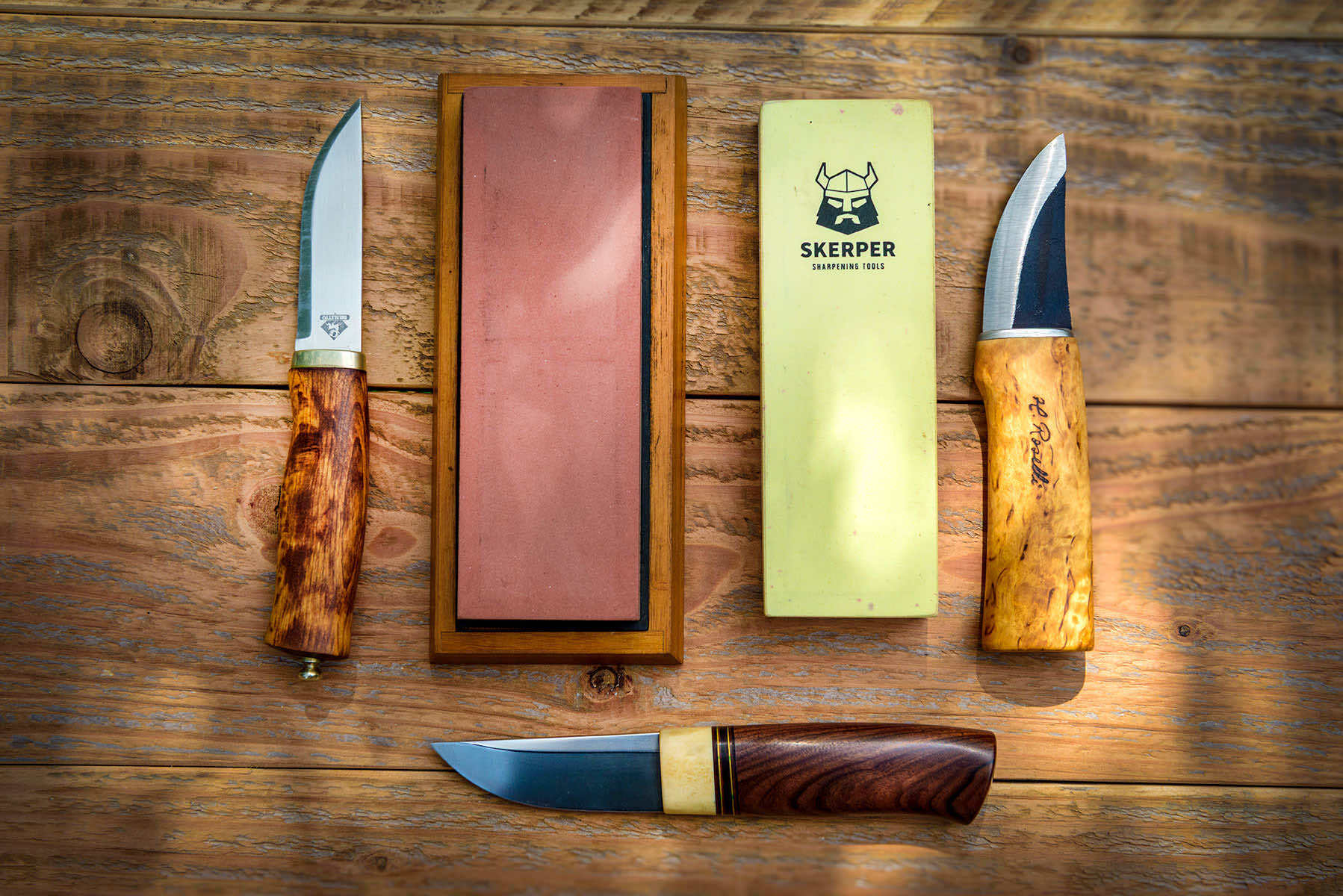
Recommended equipment (simple and effective)
- A flat stone (Japanese water stone preferably):Grain 400-600 (if the blade is really blunt or damaged)
- Grain 1000 (sharpening current)
- Grain 3000 to 6000 (finition)
- Leather to sharpen (strop) + abrasive paste (green or diamond) for finishing
- Water (for water stones)
- Option beginner ultra-economic: flat board + wet glass paper (grains 400 → 1000 → 2000)
Avoid rifles to sharpen standard and fixed angle systems for V-shafts: they are not suitable for scandi.
Steel comparison carbon vs stainless steel
Steel carbon
Sharpening easy and fast, very aggressive sharp (ideal sculpture/wood). Rust easily → dry and oil. Patina Over time.
Oxidable
Resistant to corrosion and moisture. Sharpening A little longer. Often squeaking a little less « biting » on the wood.
For a puukko (scandi) : carbon If you're talking about the blade, stainless steel If you want zero constraint.
Damas steel
Different steel layers forged together. Especially aesthetic (corrugated grounds). Performance depends on the steels used, not the pattern.
Maybe carbon (rust, sharpening easy) or stainless steel. More expensive. On one puukko : beautiful, but not necessarily sharper than a good carbon Simple.
INSTRUCTIONS ON PIERRE NOT TOO
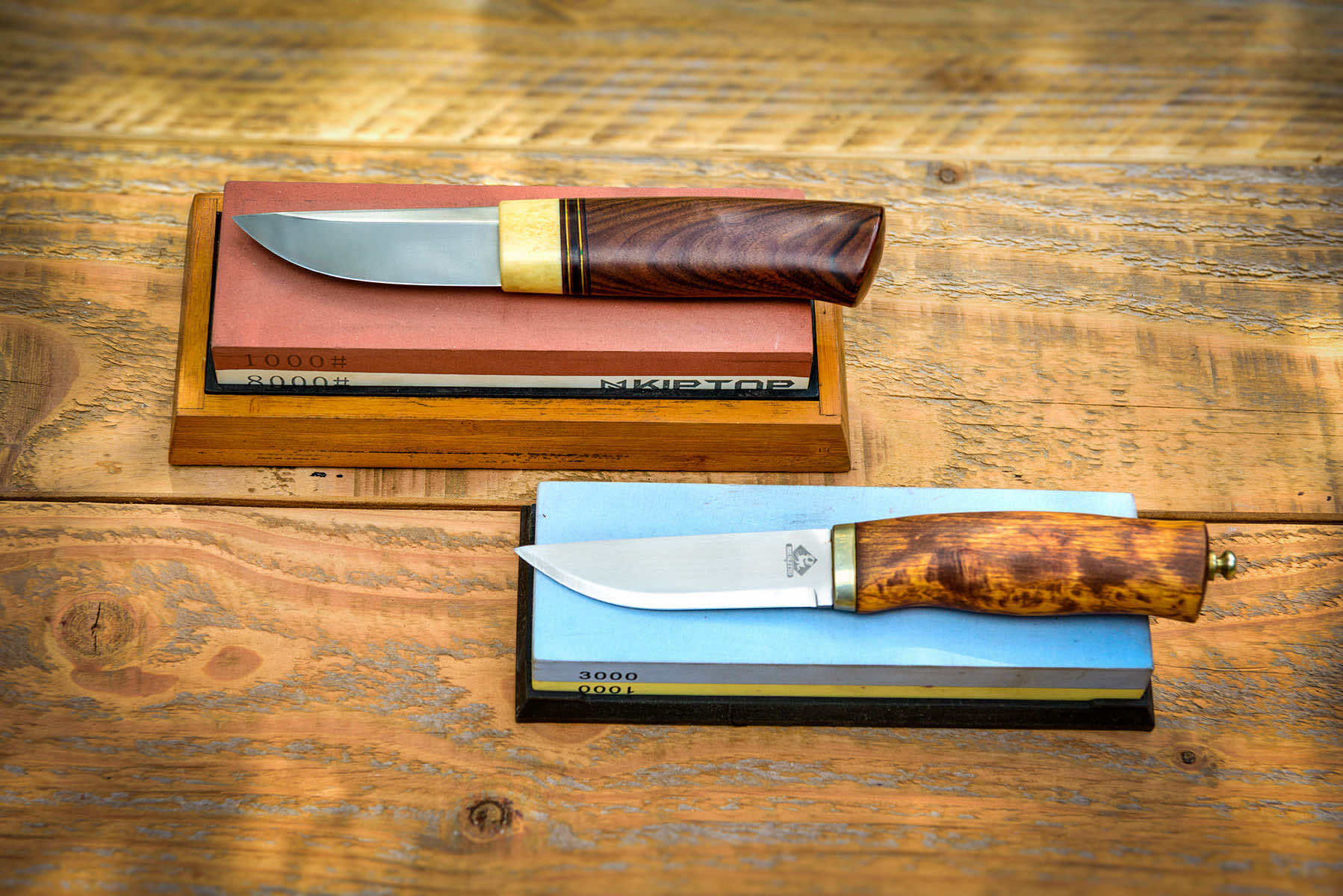
Traditional puukkos have a grind flat that descends directly to the wire, without secondary bevel. This is precisely what makes them very easy to sharpen once we understand the gesture: the wide bevel serves as a natural guide.
What is a scandi grind?
One scandi grind has a single flat bevel extending just below the center point of the blade to the sharp edge. This unique design eliminates the need for a secondary bevel, which makes it grind Scandi exceptionally sharp and easy to maintain. This design makes the knife ideal for woodworking, and outdoor activities, where precision and reliability are paramount.
1. Prepare the stone
- Soak your water stone 5-10 minutes (unless it is a diamond or oil stone).
- Place it on a stable and non-slip surface.
- Find the angle (this is the most important), about 12°.
The angle of sharpening optimal for knives grind Scandinavian is a subject of many discussions among enthusiasts. In general, most puukkos work better when sharpened at an angle of 12 degrees per side for blades up to 2.5 mm thick and 14 degrees thicker blades. - Apply moderate pressure with the fingers directly on the bevel (especially on the 40-50 % front of the bevel).
- Performs back and forth movements (round and forth) over the length of the blade.
- At the tip (curved part), the handle to keep the bevel in full contact.
- Alternates sides regularly. (same number of passes)
- Continue until you form a net morfil on all the thread.
- Some prefer small circular movements rather than linear back and forth.
It helps to better distribute the wear of the stone and avoid scratches that are too marked in one direction.
Same principle: bevel well flat + bevel pressure.
Tip beginner : Colour the bevel with black felt. When the felt disappears evenly, you're flat.
2. Switch to finer grains
- Repeat the same gesture on finer grains.
- Recommended order of progress:
- Average grain (800-1000) → yarn formation
- Fine grain (3000-6000) → refinement
- Eliminate the morfil. Some very light passes alternating sides.
3. Leather finish (strop)
- Pull the blade back forward (never the edge first) 20-30 times on each side.
- The result must be razor.
Full article: Techniques sharpening leather for puukkos
4. Common mistakes to avoid
- Raise the back of the blade too (involuntary creation of a micro-bevel too large)
- Work only the middle of the blade and neglect the tip
- Too high pressure on fine grains
- Forget to dry and oil immediately (especially on steel) carbon)
5. Daily maintenance
A simple passage on the leather after use is often enough to maintain an excellent edge for a long time.
Full article: How to maintain your puukkos
PRACTICAL GUIDE TO CHOOSE I've got a little water.
1. Understand grains (granulometry)
- The lower the number, the more abrasive the stone (it removes matter quickly).
- The higher the figure, the finer it is (it polishes and refines the edge).
| Grain | Main use | When to use | Method of use |
|---|---|---|---|
| 200/600 | Repair / trimming | Very blunt, chipped or damaged blade | Firm pressure, long and regular movements. A lot of water (or oil). Remove the metal quickly to reform the edge. |
| 800/1000 | Sharpening Main | Routine maintenance (most important) | Moderate pressure. Alternate sides regularly. This is the stage where the real sharpness is formed. Well lubricate. |
| 3000/6000 | Finishing / polishing | Shavering and beautiful rendering | Light pressure. Short and controlled crossings. Look for a shiny and smooth edge. Gradually reduce pressure. |
| 8000 + | Polishing mirror | Optional, for perfectionists | Very light pressure (almost the weight of the blade). Soft movements. Often followed by leather (strop) with abrasive paste. |
You almost never need to go below 1000 if you regularly interview your blade.
2. The best choice to start
Double-sided combined stone 1000/3000 (or 1000/6000).
This is the ideal compromise:
- Face 1000 → you recreate the thread
- Face 3000/6000 → you end up razoring
A single stone is largely enough to start and covers 90% of the needs of an owner of puukko.
3. Large families of water stones
- Dipping stones (soaking): King, some Naniwa/Suehiro.
You plunge them 5-15 min into the water before use. They produce pleasant abrasive mud and are very tolerant to the beginners. - Splash-and-go (wet just on the surface): Shapton Glass, some Naniwa Pro/Chosera. Ready in 10 seconds, harder, wear less quickly, very regular.
4. Recommended (reliable and accessible)
- King: (best value for money to start with)
Japanese classic, very indulgent, excellent feedback. The King 1000/6000 has been a standard for years. - Naniwa: (Chosera Professional)
Excellent sensation, fast and regular cutting. An upper step in comfort and performance. - Shapton: (Glass or Pro)
Very hard, splash-and-go, keep their flatness for a long time. Ideal if you want something precise and lasting. - Suehiro Cerax: very good value for money, nice to use.
Avoids cheap, low-quality, no-name stones (they wear too fast and give an irregular result).
5. Other important criteria
- Size: minimum 18-20 cm long × 5-6 cm wide (practical for one puukko).
- Planet: A stone that digs too fast is frustrating. Provide a flattening plate (Atoma 140 or equivalent) fairly quickly.
- Anti-slip holder: essential (rubber base or dedicated support)
- Budget beginner : 30-60 € for a good combined King or equivalent. Over 80-100 €, you get into the really good (Naniwa Pro, Shapton).
6. Concrete recommendation according to your profile
- Beginner pure / tight budget → King 1000/6000 (or 1000/3000)
- Good value for money and comfort → Naniwa or Suehiro 1000 + 3000
- Practical and sustainable (splash-and-go) → Shapton Glass 1000 + 4000/5000
- You sharpen often and you want the top → Naniwa Professional
In summary for a puukko : starts with a combined stone 1000/300 or 1000/6000 brand King or Naniwa. It's simple, efficient, and perfectly suited to your needs.grind Scandinavian. You can always complete later with a larger grain (400) if you damage a blade, or a thinner grain for polishing.


TECHNICAL D SHARPENING ON THE TERRAIN WITH A POCHER.
With a little practice, a knife Scandi (Mora, Casström, etc.) becomes razor again in a few minutes, even in nature. This is one of the reasons why this geometry is so appreciated by Scandinavian and European bushcrafters.
Preparation
Check the edge. If the blade is just a little blunted, start directly at the fine grain. If it is very blunt or chipped, start with the more aggressive grain.
Bevel positioning (key point)
Place the wide Scandinavian bevel entirely flat on the diamond plate. You must feel that the entire bevel surface is in contact. It's the « natural guide » of l grind Scandi : does not lift the back of the blade.
Movements
Performs forward-to-rear passages (or rotary movement) by keeping the bevel perfectly flat.
Moderate pressure (diamond cuts well, unnecessary force).
Work in zones: starts with the right part (talon → belly), then the belly, and finally the tip.
At the tip (curve), slightly increases the handle to keep contact on the entire bevel.
Alternance and formation of the morfil
Make 10 to 20 passes on one side, then on the other. Continues until you feel a fine biting over the length of the edge. Then alters to eliminate it gradually.
Finish (optional but recommended)
Pass on a small leather with or without dough. 10-20 passes on each side to eliminate the last imperfections and get a razor edge.
Field specific tips
Work on a stable surface (knit, stump, backpack...).
Cleans the diamond plate (water + cloth) regularly to keep it effective.
For quick maintenance between two intensive uses: few fine grain passes are enough.
Benefits of this method
Extremely simple: no need to guess the angle.
Quick (5-15 minutes depending on the state of the blade).
Very effective for woodworking, bushcraft and outdoor tasks.
FAQ
Frequently asked questions are clear and practical for sharpening knives on stone sharpen.
1. What is the difference between sharpening and sharpening?
In concrete terms, the two terms often refer to the same action: removing material to reform the edge.
- L sharpening (or sharpening on stone) removes steel to recreate the wire.
- Affiliation (fusil or strop) simply re-aligns a wire already present without removing a lot of material.
2. Should the stone be soaked before use?
- Yes, for most classic water stones (King, Naniwa traditional...) 5 to 15 minutes until the air bubbles stop rising.
- Stones « splash-and-go » (Shapton, some Naniwa Professional) are content with a simple surface watering.
- Never oil on a water stone (it would be irreparably damaged).
3. What stone grains to use?
- Grossier (220-800): repair of sharpness or very blunt blade.
- Medium (1000-2000): current sharpening (most important).
- End (3000-6000): polishing and refining.
- Very fine (8000+): mirror finish (optional).
To begin: A combined 1000/3000 stone is enough.
4. What angle of sharpening choose ?
- Puukko Scandi Grind: about 12° per face
- Japanese knives (double bevel): about 15° per face.
- Western knives: 15-20° per face.
- More robust blades (outdoor, chopper): 20-25°.
5. What angle to use?
The same angle as sharpening (often 15-20° for knives, flatter for straight shavers where the back remains in contact). Some lower the angle by 1-2° to avoid rounding the wire.
6. How do I know I formed a morfil?
Gently pass the finger perpendicular to the edge (never in the direction of length). You must feel a fine metallic blush on the other side of the worked face. Once the morfil is formed over the entire length, go over the other side to eliminate it.
7. How often do you sharpen on stone?
- Normal domestic use: every 1 to 3 months (or as soon as the cut becomes less fluid).
- Intensive (professional) use: Every 1 to 4 weeks.
- Between sharpening, use a rifle (in moderation) or a strop for maintenance.
8. How do I know my knife is sharp?
- He slices a piece of paper suspended effortlessly.
- It cuts the skin of a mature tomato without slipping.
- He shaves a hair or cuts newsprint in « V » clean.
9. Can we sharpen all the knives on stone?
Yes for smooth steel blades.
Avoids or adapts to:
- serrated blades (special).
- Ceramic blades (diamond stone only).
- Very cheap knives Very soft steel (they wear fast).
10. What are the most common mistakes?
- Angle irregular.
- Pressure's too high.
- Pierre insufficiently wet.
- Forget to form and eliminate the morfil.
- Move too quickly from coarse grain to very fine grain without intermediate steps.
- Do not clean the blade and stone after use.
11. How maintain His stone after use?
Rinse it thoroughly with clear water, wipe it and let it dry completely in the open air (never in the direct sun or near a source of heat). Put it flat, away from dust.
13. What are the most common mistakes?
- Angle irregular.
- Pressure's too high.
- Pierre insufficiently wet.
- Forget to form and eliminate the morfil.
- Move too quickly from coarse grain to very fine grain without intermediate steps.
- Do not clean the blade and stone after use.
Conclusion:
Scandi grind is designed to be simple. Once the bevel is flat on the stone (or pocket diamond), the angle is on its own. Starts with a combined stone of 1000/3000 or 1000/6000, forms the morfil, refines, and then passes to leather. Regular maintenance is sufficient: the puukko razors again in a few minutes, both at home and in the field.
We don't get a razor edge at first. Sharpen is an art that requires long hours of practice. Sometimes, at the end of the day, the need for a bandage... I speak with knowledge. Always be very careful and focused on what you do. If you can't be in the moment, it's better to drop it and resume later.
Thank you very much for going through this article. If you don't want to miss the following, subscribe to the newsletter (it's just below). I usually answer the questions quickly enough, so if you have any, don't hesitate, you can comment on it.
To complete this article :
Warm regards,