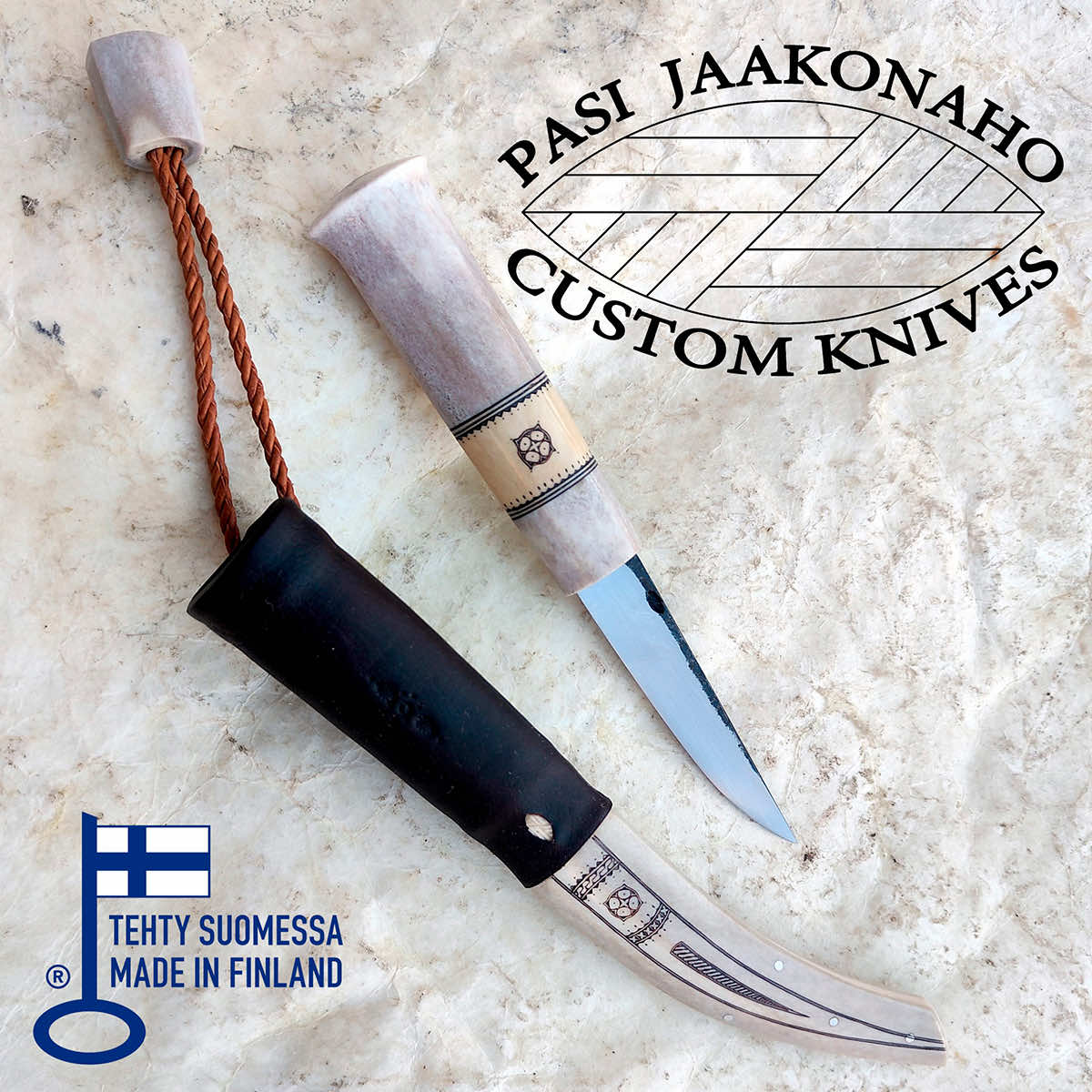
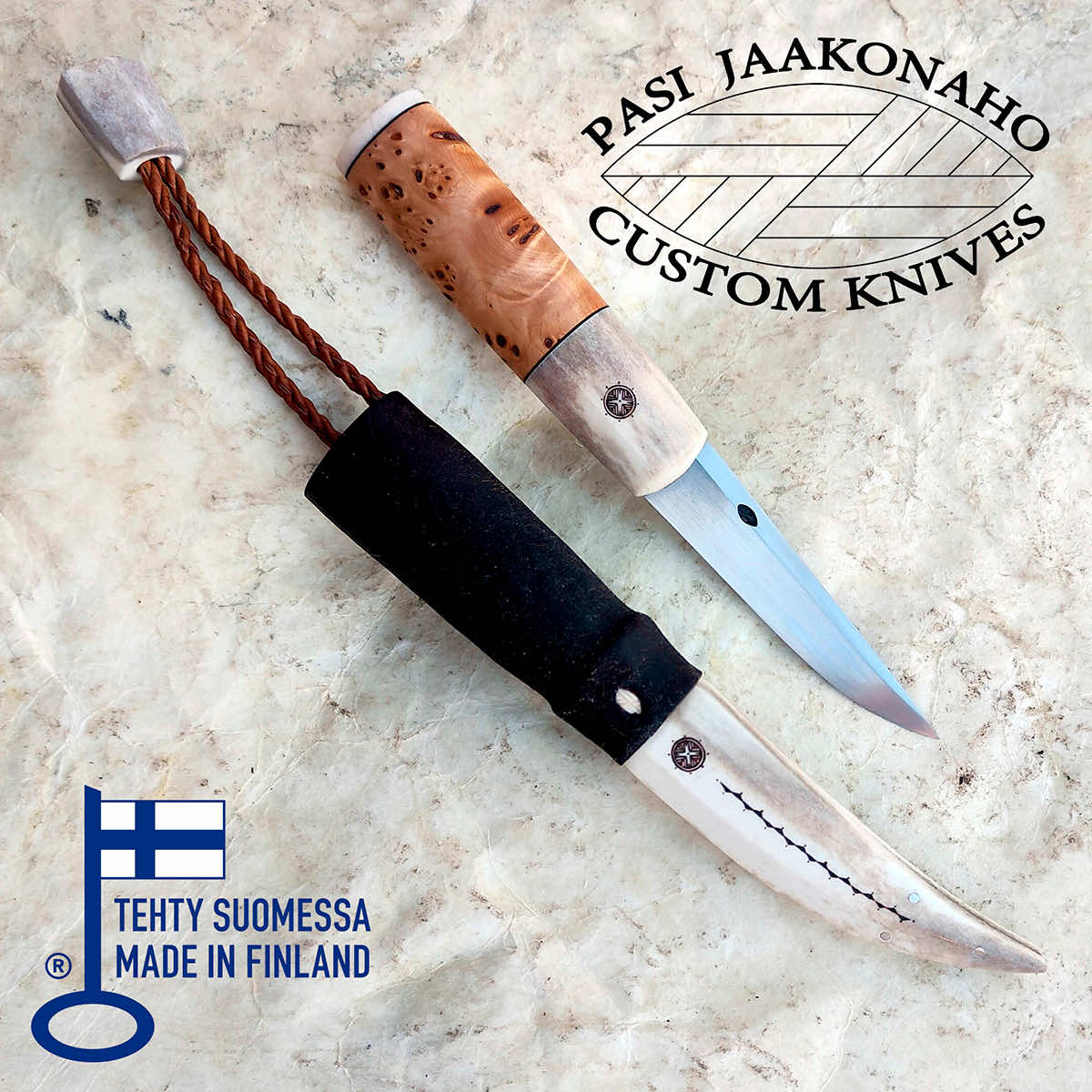
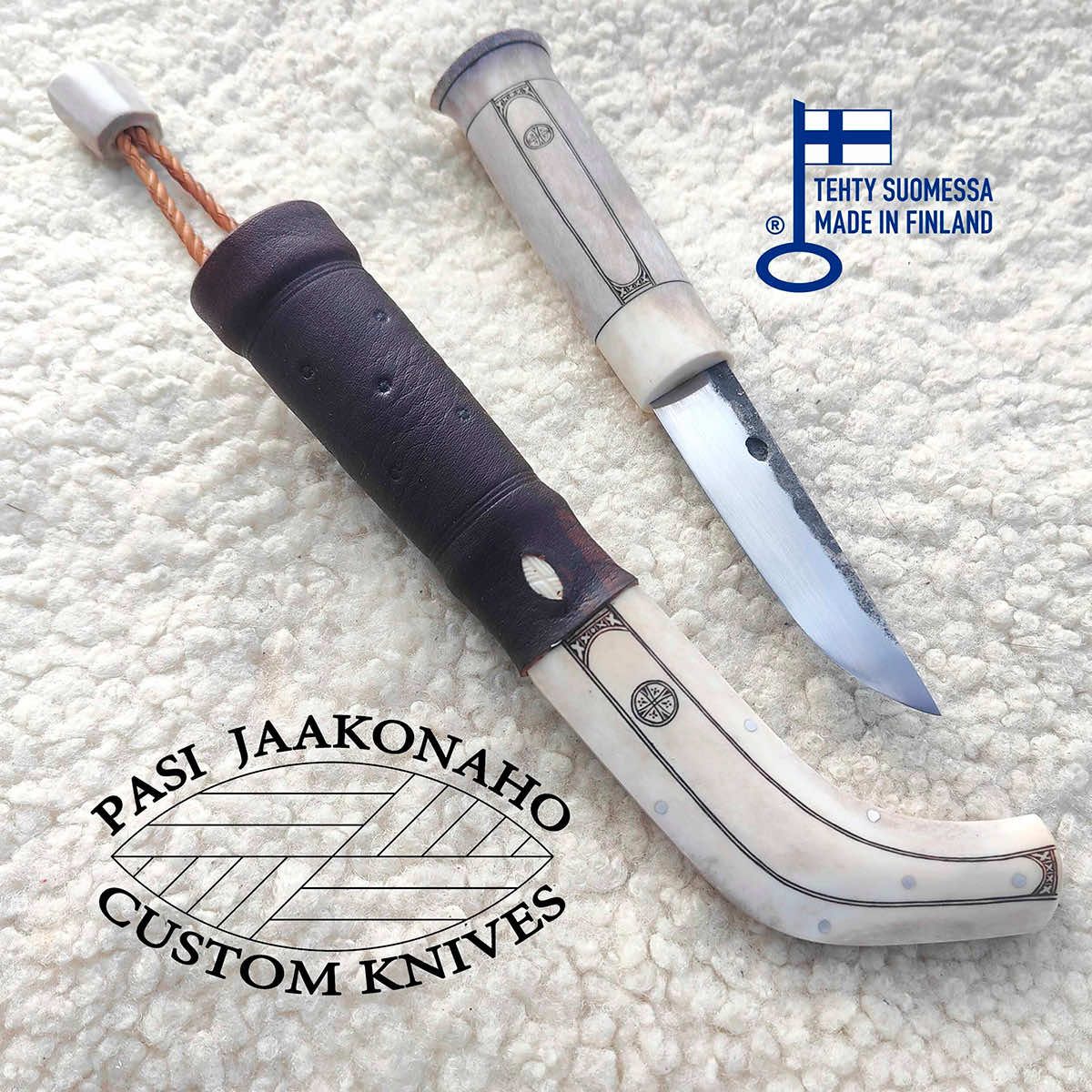
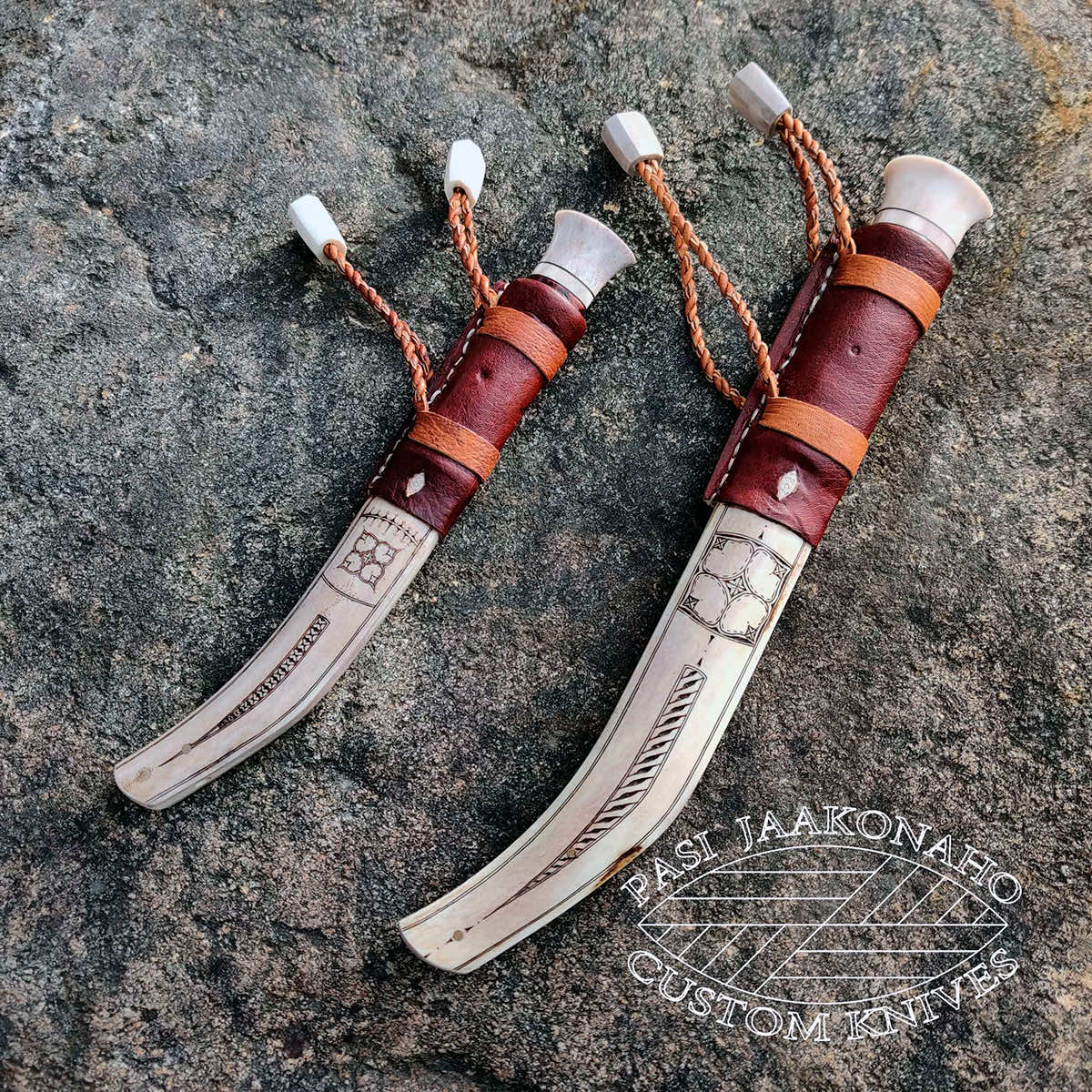
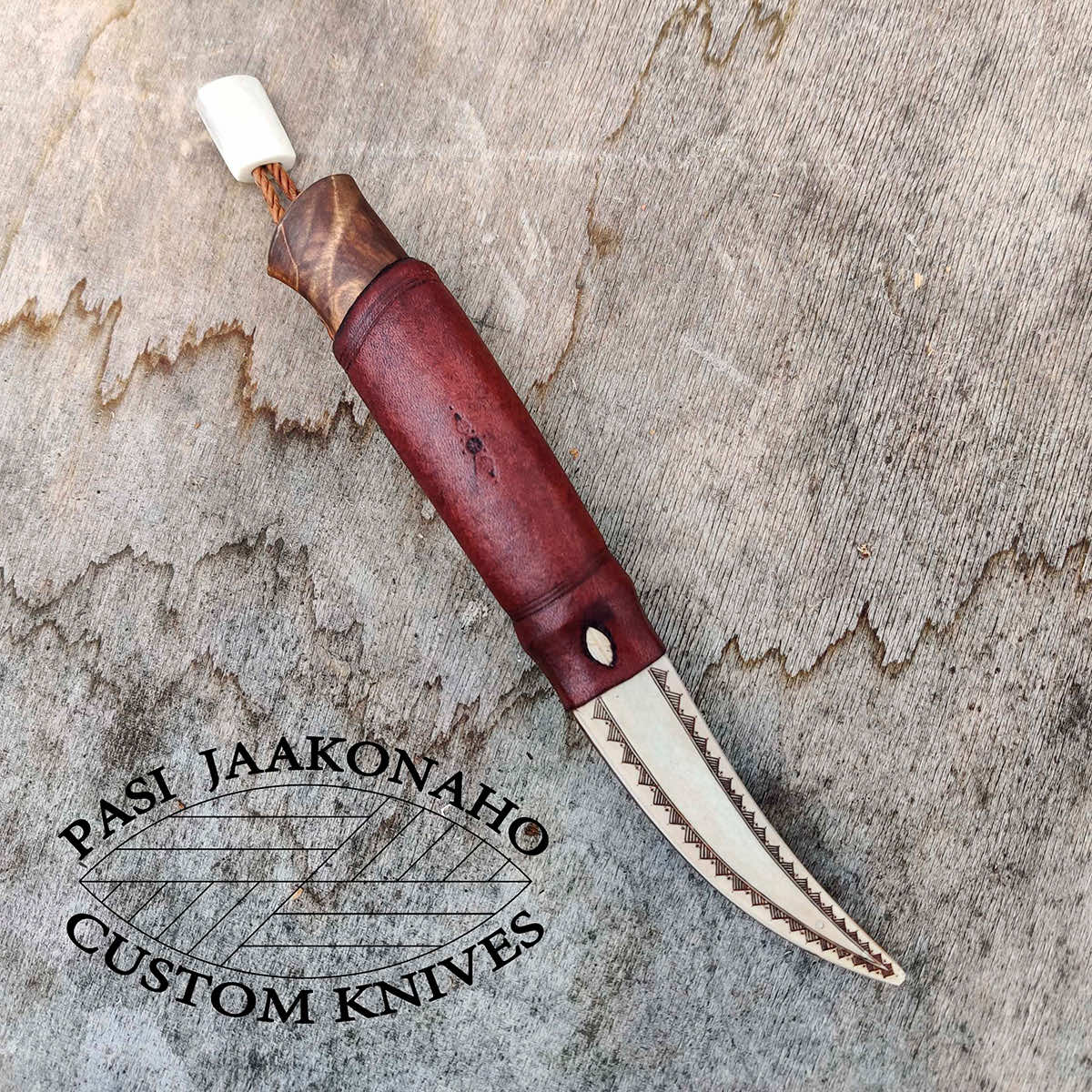
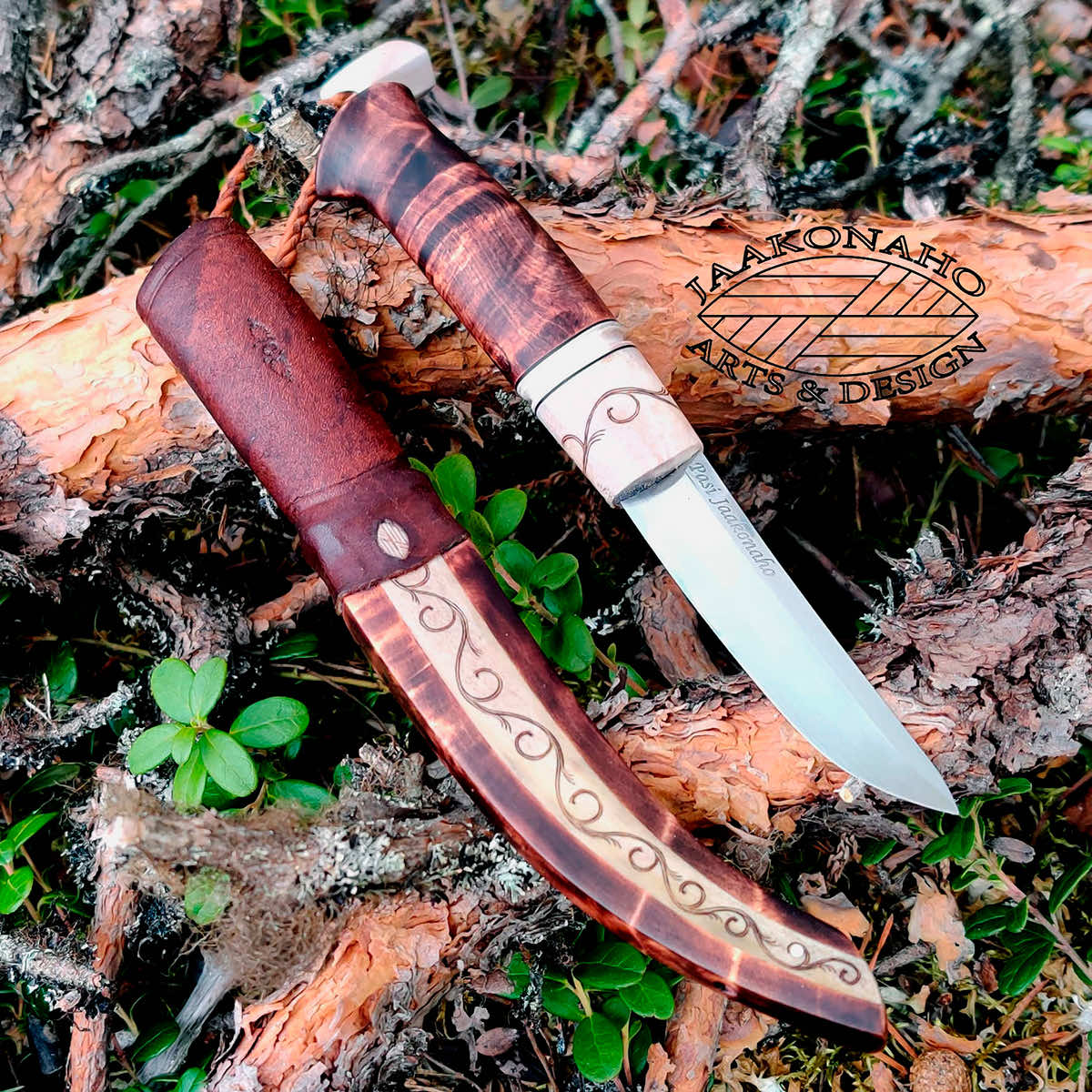
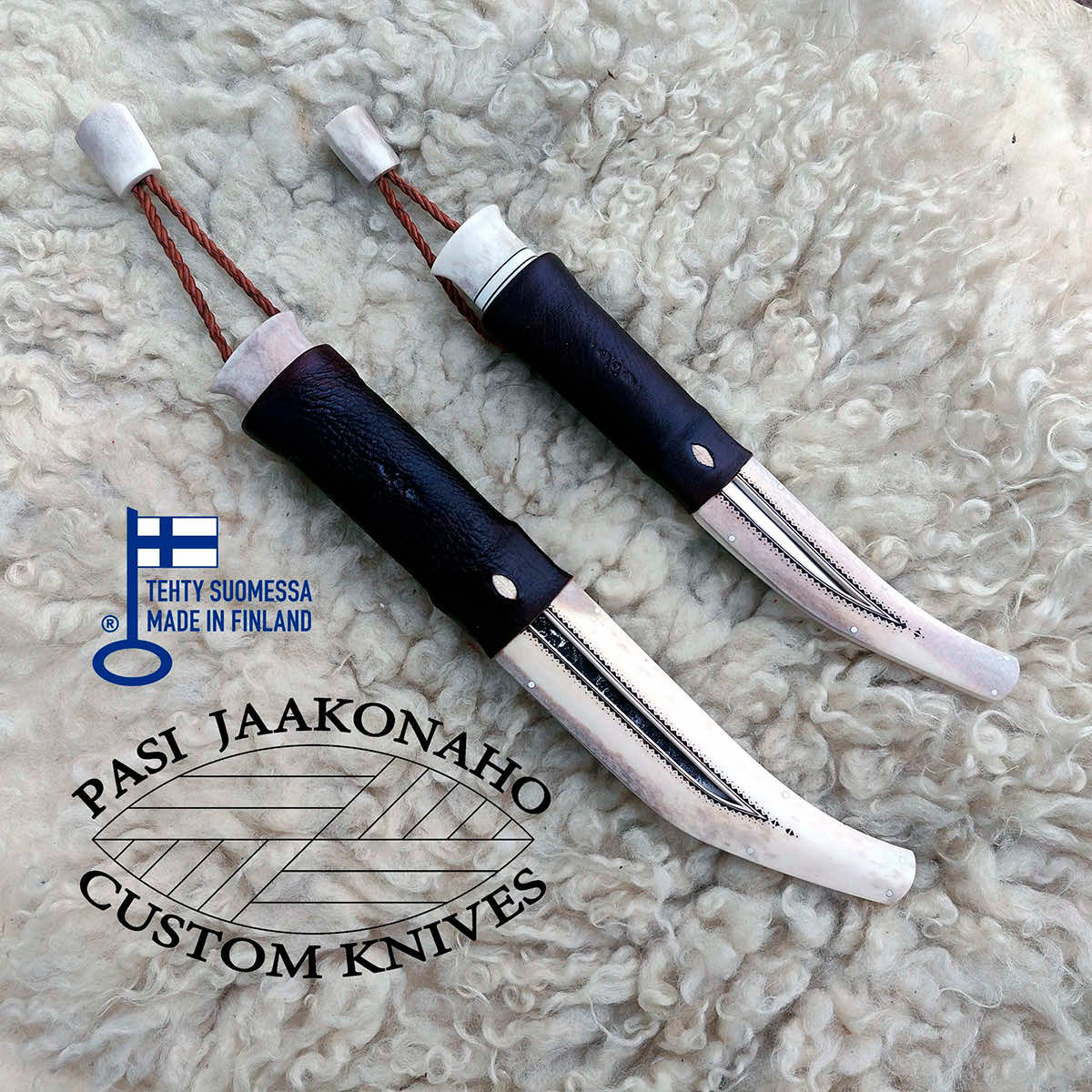
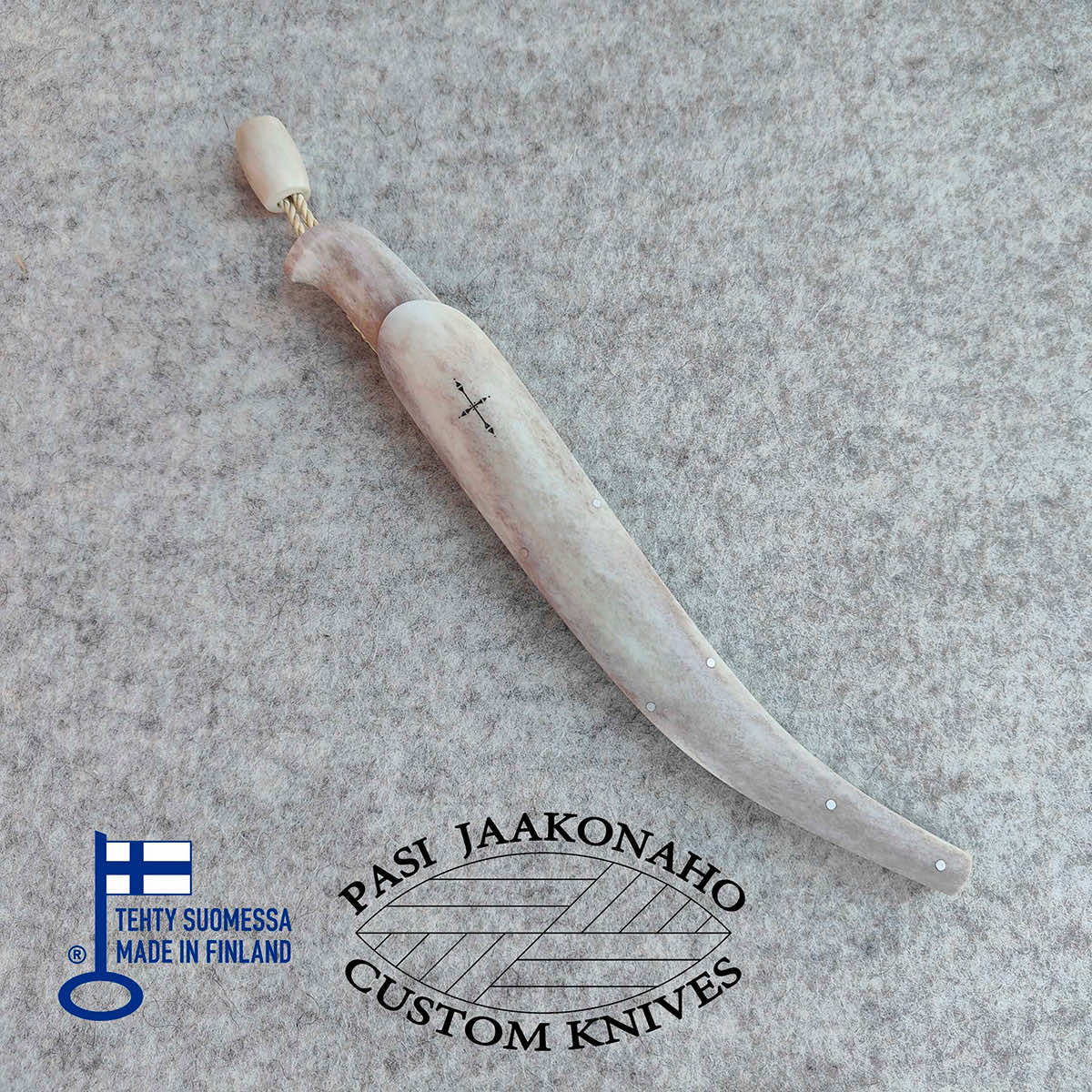
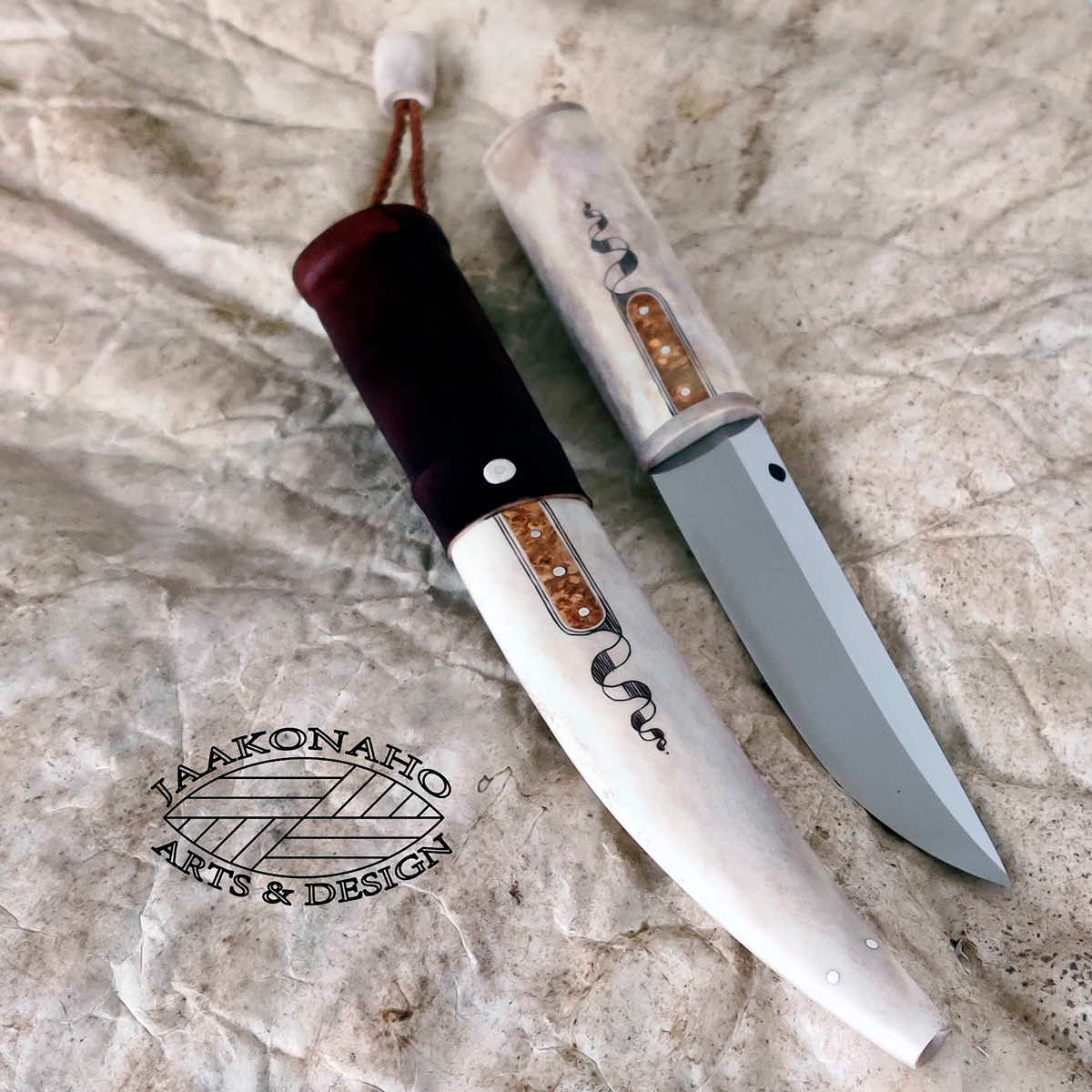
Pasi Jaakonaho is one of the few contemporary artisans to engage so closely with traditional Sami gestures and a contemporary aesthetic. His engravings on reindeer wood are a living demonstration of the mastery of his art. An art mastered by the best artisans.
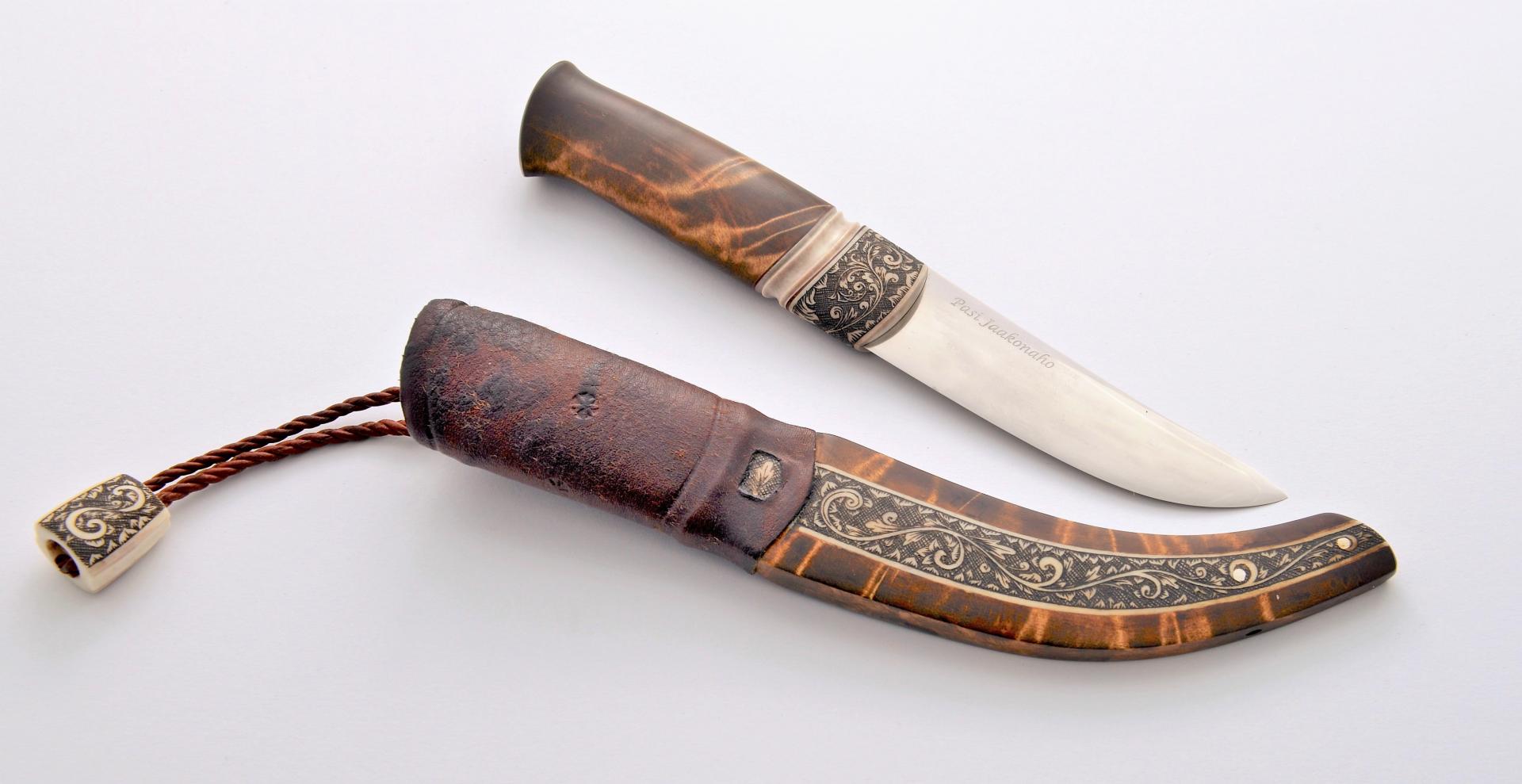
INTRODUCING
I was born in Haapajärvi, North Ostrobotnia, and I currently live and work in Inari, northern Finland. I am master cutlery and designer (graduated from a university of applied sciences). I am currently a researcher at the University of Lapland and my doctoral thesis focuses on the puukko.
My goal is to design and manufacture high quality and sustainable consumer goods and works of art. I want to contribute to sustainable development and I try to use mainly Finnish natural and recycled materials in my work.
FOCUS ARTISAN: PASI JAAKONAHO
Exploration of its work
Pasi Jaakonaho (Jaakonaho Arts & Design) mainly produces unique pieces or in very small series. His work is at the crossroads of Finnish/Sami tradition and a sensitivity of contemporary designer.
General characteristics of his work
- Blades: Almost always forged by hand (steel) carbon classics like 80CrV2, 100MnCrW4, 115CrV3, sometimes damas, N690, Elmax, RWL34...).
- Handles : Very often in reindeer wood + curly birch + interlayers in leather reindeer hand tanned.
- Furs: leather tanned by itself, often with reindeer wood inserts or birch, silver rivets 925, hand engravings.
- Aesthetic: clean lines, excellent proportions, neat details (gravures, chip carving). Each room is unique.
- Philosophy: local and recycled materials, durability, respect for laponne nature.
Types of pieces he most often makes
- Puukkos classics (8–10 cm of blade) – its main production.
- Leukus (larger Sami knives, 13–18 cm). (Article on leuku)
- Artistic pieces / collector (names like Lilja, Flower, Goth, Cor, Liana, Näpsä, etc.).
- Double knives (set puukko + small knife). Occasionally, daggers or more experimental pieces.
- Dagger 2025 – RWL34 blade, handle reindeer wood + birch, silver rivets.
- Kokosarvituppipuukko – sheath Made entirely of reindeer wood.
Where to see his work
- Official site: jaakonahoartsandesign.com
- Email: pasi@jaakonahoartsandesign.com
- Phone: +358 40 749 4782
- Lamnia: best current window (many copies photographed)
- Instagram: @jaakonaho a d
- Exhibitions: regularly present at Solingen, Paris, Milan, Helsinki Knife Show, and Craft Museum of Finland.
- Indicative prices: the puukkos « Standard » are generally from 550 to 900 €. Highly worked parts (complex engravings, carved sheaths, premium steels) often exceed 1000–1500 €.
Reputation
It is regularly listed among the best Finnish makers today. His puukkos are highly sought after by international collectors. They are found in Lamnia (the Finnish reference distributor).
Pasi Jaakonaho perfectly embodies the spirit of puukko Modern: anchored in the Nordic and Sami tradition, but with a very high artistic and technical requirement.


THESIS ON THE PUUKKO FINLAND
The main doctoral research in progress on the subject is that of Pasi Jaakonaho.
Pasi Jaakonaho's thesis
- Title / subject : Doctor of Arts puukko Finland.
- University: of Lapland (Rabbit yliopisto), Rovaniemi.
- Status: PhD student since 2021. In his 2023 CV, the defence was estimated for May 2025. (To date, the thesis is not yet published, I have found nothing on the website of the University of Lapland...)
- Particularity: he is described as the first researcher in the world to conduct a doctoral thesis specifically devoted to the puukko Finland.
- Approach: as a puukkoseppämestari (master blacksmith), designer and teacher, his research probably combines the technical/craft, cultural, historical and design aspects of the puukko. He won the Finnish National Knife Championships in 2016.
See article: The cutlery of the year in Finland since 2011
Pasi Jaakonaho is therefore both a high-level practitioner and academic researcher on the subject.
At present, the only doctoral thesis specifically identified on the puukko Finland is one of Pasi Jaakonaho at the University of Lapland. It is an important step because it raises the puukko a subject worthy of in-depth academic research at the highest level.


For a Finn, the puukko is both the most important tool and the most feared weapon. We can say that the puukko For a Finn, it is as important as the samurai sword for the Japanese.
The engraving on reindeer wood requires patience, precision and a great knowledge of the material. Few artisans reach a level where the gesture becomes almost invisible and the pattern perfectly integrated into the shape of the object.
Pasi Jaakonaho, master blacksmith and designer based in Inari, Finland, is one of these rare artists. On its handles and reindeer wood sheaths, we observe an exemplary mastery of traditional Sami techniques: extremely fine linear engravings and subtle use of pigment to highlight patterns.
His work perfectly illustrates what these techniques can give when pushed to their highest level: a balance between Nordic authenticity and contemporary refinement.
JAAKONAHO PASI GRAVURE TECHNOLOGY
In the pure Sami/Finnish tradition
Pasi Jaakonaho mainly practices hand engravings (handmade engravings) and chip carving on reindeer wood (poronsarvi), sometimes combined with birch. Here are the detailed techniques, in the most common order at home and in the Duodji (Sami craft).
See article: Duodji or craft excellence Sami
1. Classic linear engraving
This is the most widely used technique on reindeer wood.
Process:
- The pattern is first drawn in fine pencil.
- A very sharp knife (or a special engraving tool) is used, held like a pencil.
- The tip is pushed along the line to create a very fine V-row (a depth of only a few tenths of a millimetre).
- The reverse direction is used to clean and deepen the furrow slightly.
The thicker lines are made by tilting the knife further; thin lines holding it almost vertical.
Typical reasons:
- Geometrics (losanges, zigzags, braids, stars, hearts)
- Floral or stylized (especially in North Sami style)
- Border « braided rope »
After engraving, a pigment (coal, cinnamon, coffee, or commercial pigment) is often rubbed into the furrows to bring them out in contrast to the white of the reindeer wood.
2. Chip carving (cut of chips / triangles)
Very present in the descriptions of the pieces of Jaakonaho (« handmade engravings and chip carvings »).
Technique:
- First we trace the base of the triangle with a line.
- With the knife tip held like a punch, one makes a unique cut from the base to the top.
- The small triangular shaving is removed.
- Repeat to create rows of triangles, borders, or relief patterns.
- This technique gives a more sculpted and three-dimensional effect than the simple line.
3. Other complementary techniques
- Engraving in relief / light sculpture: for deeper patterns or organic forms.
- Combination with wood: on the inserts of curly birch, one sometimes finds larger chip carving.
- Finishes: 925 silver rivets, sometimes light tints or oils to protect and highlight contrasts.
Tools used
- Very sharp engraving knives (often homemade)
- Small scissors or fine gouges
- Sometimes dentist or jeweller tools for very fine details
- Fine abrasives for polishing around engravings
Jaakonaho Style
It remains true to the Sami spirit (geometrics + nature) while bringing a designer sensitivity: the patterns are often more airy, modern and perfectly integrated into the shape of the handle or sheath. He never overloads the room.
These techniques require great control: the reindeer wood is hard and brittle, and the slightest error is visible. That's what makes Jaakonaho's pieces so precious.
SUMMARY
In Inari, in Finnish Lapland, is Pasi Jaakonaho's forge.
Master of Arts and Crafts, He is an exceptional cutlery, renowned for his innovative spirit. In his workshop, Jaakonaho creates real collection pieces. Limited editions, materials used and hand forged blades make knives puukko Jaakonaho's unique objects, both suitable for a collection and for everyday use.
Jaakonaho combines the Nordic cutlery tradition with creative solutions. It favours recycled and natural materials. When designing and shaping, he often gives free rein to his artistic inspiration. He drew inspiration from the harmonious fauna of Lapland, his native region. During his hikes, he finds not only inspiration, but also materials that can be used to make his knives. Jaakonaho collects reindeer wood in these areas.


Conclusion:
By buying a knife puukko Pasi Jaakonaho, You have the certainty of owning a single piece and not found elsewhere. Each creation of Jaakonaho is the result of exceptional Finnish craftsmanship and an artistic vision of rare precision. The knives puukko Jaakonaho is an ideal gift, even for the most demanding collectors.
In a parallel life, I am a professional photographer specializing in landscape and nature in general. I invite you to discover a road trip photos of 4,000 kilometers in Finland on my site Nature Photography. It was during this trip that I fell in love with the puukkos.
Thank you for reading this article and sharing it if you liked it.
Warm regards,
Photo credit: @Pasi Jaakonaho