
Marttiini
SINCE 1928
The Puukkos of Rovaniemi
Founded in 1928 by the Finnish blacksmith Janne Marttiini, the Marttiini brand has built a reputation as a manufacturer of high-end Scandinavian knives, designed for active outdoor use.

Manufacturer: Marttiini – Finland
Janne Marttiini began forging in Rovaniemi in 1928. The Ilves model has hardly aged at all. Four million knives later, the brand is owned by Rapala and some of the blades are made in Pärnu. The most widely seen puukko in the world — though not the most handcrafted.
- Background: from Kierinki blacksmith to Rapala group.
- Forces: easy wire, Finnish price.
- Best-sellers: Lynx and Condor.
- Table: Six models, two logics (wood / rubber).
- FAQ: Estonia, HRC, first purchase.
- Conclusion: entry to Lapland.


History of the company Marttiini
Johan Henrik « Janne » Marttiini, Born on 2 May 1893 in Kierinki (Sodankylä) into a devout family. At the age of 16, he became an apprentice blacksmith with Matti Tapio in Rovaniemi. He returned as the village blacksmith; his reputation extended as far as Vadsø (Norway).
1928 : J. Marttiini’s Knife Factory Ltd., Vartiokatu, Rovaniemi. He sells his goods by bicycle throughout the region. First unnamed model: birch + forged blade.
Local competition: Bricklayer Kalle Palmu recommends Lynx / Ilves. Still in the catalogue. Over 4 million Ilves.
Janne: blacksmith, trader, preacher, traveller. First trip to the US in 1952. Toivo (son) expanded exports of the mesh model in the 1960s. Presidential Export Award in 1967.
1944 : Factory partially destroyed (Lapland War). Reconstruction.
Management: Toivo, then Lauri (1975), Päivi Ohvo DG in 2001.
Highlights / weak points
Forces
- Price. A Lynx or a Condor costs a fraction of the price of a Roselli or Helle.
- Factory-sharpened blade, often extremely sharp (‘the sharpest choice since 1928’). Distinct puukko shape. Chrome stainless steel ~13 per cent, 53–55 HRC: can be sharpened anywhere, even on a stone. Carbon steel (Vuolage, Lumberjack, some Kierinki) is even sharper.
- Condor: rubber handle + guard, wet hunting. Classic nets: global bestsellers (US fishing). Available everywhere. Leather sheath good value for money. Laponie shops = brand story.
Weakness
- Variable finish (series). Lacquered necks, which can sometimes be slippery, contrast with Roselli/Helle oiled birch.
- Variable finish (series). Handles sometimes slippery varnish against oiled birch Roselli/Helle.
- Huge catalogue (gifts, bottle opener, junior...).
- Made in Estonia for the majority of the production: something to be proud of, not something to hide. Less of a ‘workshop’ and more of a group brand.
In one sentence
Marttiini wins on price and ease of use; it is neither the thread nor the workshop of a Roselli.
Better sales
Three lines. The puukko-Icon, hunting-practice, netting (outside puukko but inseparable).
1) Lynx / Ilves (e.g. 131, 134, 121)
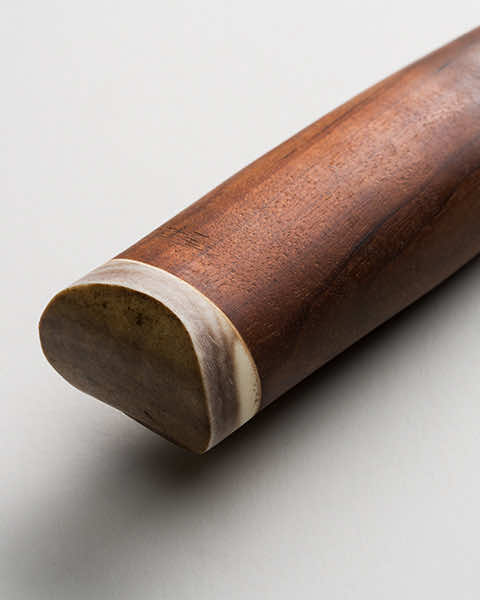
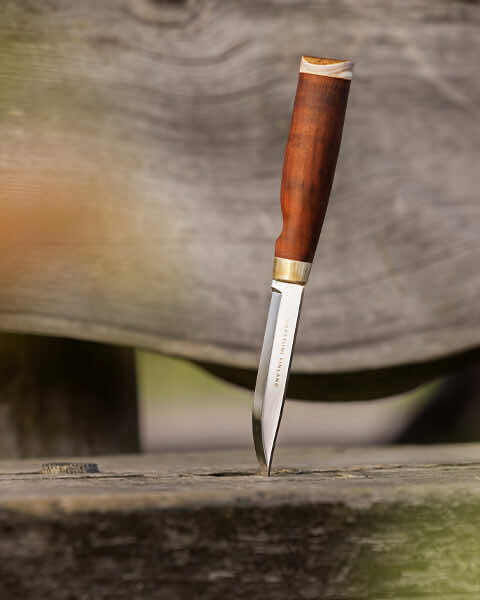
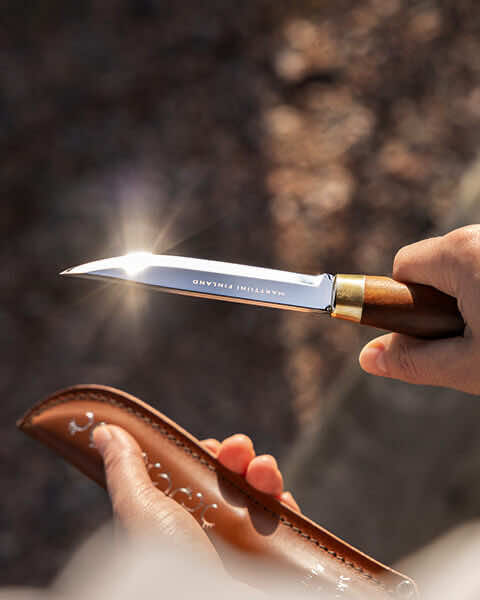
The first one. Blade ~9–13 cm depending on the version, chrome-plated stainless steel, visakoivu, leather sheath with a Lapland design. ~€45–80. The Marttiini is the one to go for if you want a genuine, traditionally shaped puukko.
2) Condor Classic / Skinner
Lynx-style blade + ribbed rubber handle + guard. Skinner: winner of the ERÄ magazine test. ~€40–50. Hunting, damp conditions, the first knife ‘that really does the job’. Classic = versatile; Skinner = skinning.
3) Classic Filetti (15 / 19 cm, Superflex)
50 years in production, millions of households, at the heart of US exports. Not a puukko: to be mentioned in the fishing section, not to be confused with the forestry comparison.
Mention should also be made of:
Lumberjack: carbon, bushcraft budget.
Kätevä / Kaamosjätkä: Finnish drawer.
Lapinleuku: camp, other family.
Luxury series (wood, reindeer antler) : gift.
Your first Marttiini
- The Lynx / Ilves model: a timeless design available in a wide range of finishes. A versatile puukko with its own distinct character and an attractive price (from 46 to 100 euros).

Board comparative
| Model | Steel | Blade | Handle | Use | Indicative price |
|---|---|---|---|---|---|
| Lynx / Ilves 131 | Stainless steel chromium ~54 HRC | ~110 mm | Visakoivu | Puukko multipurpose | ~50–60 € |
| Lynx 121 | Stainless steel chromium | ~90 mm | Visakoivu | Compact, small hands | ~45 € |
| Condor Classic | Stainless steel chromium | ~110 mm | Rubber + guard | Camp, off-road | ~50 € |
| Condor Skinner | Stainless steel chromium | ~110 mm | Rubber + guard | Unpack | ~52 € |
| Lumberjack | Carbon | ~110 mm | Dark ball | Size, bushcraft budget | ~40–70 € |
| Classic Filetti 15/19 | Stainless steel flexible | 150 / 190 mm | According to series | Net (not one puukko) | ~30–50 € |
Indicative VAT prices EU 2026. Origin: Historic Finland; part of the current production is assembled/manufactured in Estonia (Rapala, Pärnu).
FAQ – Marttiini
Subscribe to the newsletter.
FAQ
Most common issues
Still made in Finland?
Brand and story: Lapland / Rovaniemi. Volume: a great deal from Pärnu (EE) since the 2020s. Small collections and the shop remain linked to Rovaniemi. State this explicitly.
Why is steel « soft » ?
Choice: ~54 HRC to sharpen quickly in the field. This is not a hidden defect, it is the specifications. Less wire holding than a Roselli UHC or a Helle H3LS.
Lynx or Condor?
Lynx = puukko Classic, wood, Lapland look. Condor = rubber, guard, wet hunting.
Carbon steel or stainless steel?
Stainless steel for durability. Carbon steel (Lumberjack, some Lynx/Kierinki models) for size.
Good first puukko ?
Yes, especially for the price. Better than a no-name brand. Not quite as good as a top-of-the-range Mora when it comes to the consistency of the steel, but better in terms of that ‘Finnish look’ – a bonus.
Rapala, what's the difference?
Global network, networks, industrialisation. Less family independence than Helle or Roselli.
Which model should I start with?
Lynx 131 if you want a puukko. Condor Skinner if we strip. Filetti if we fish.
Marttiini Finland

Marttiini Europe
We have been making knives since 1928 – that’s almost a hundred years. Over the years, we have been privileged to hear countless wonderful stories about knives, people and the great outdoors.
Conclusion
Marttiini is the puukko that Finland has exported by the millions: Ilves, Alaska fishing nets, a shop at the Arctic Circle. Janne opened the factory in 1928; Rapala industrialised it in 2005. It is no longer a smithy in Harmoinen nor a fjord-side factory employing 20 people. People buy it for the price, the factory-made blade, the familiar shape and the availability. They do not buy it for the hardest steel or for the ‘100 per cent Finnish workshop of today’.
Face to Roselli: Marttiini = entrance / gift / fishing. Roselli = life tool, home carbon.
Do you have any questions? Drop me a line – we’re all enthusiasts here: contact(at)puukko.fr.
But, above all, don’t forget to subscribe to the newsletter.
See you soon.
Warm regards,

A–Z DIRECTORY
Ahti
Brisa
Brusletto
Casström
Fällkniven
Hell
Iisakki Järvenpää
Karesuando
Kauhavan Puukkopaja
Marttiini
Morakniv
Peltonen
Roselli
Terävä
Wood Jewel
Copyright © Photographs – Marttiini